There is a category of building in India where standard specification is simply not enough. Airport terminals. Five-star hotel towers. Cultural institutions. Corporate headquarters that are meant to be recognised from a distance and remembered up close. These are landmark buildings - and the materials specified on them carry a different level of scrutiny than a standard commercial project. When the Jali screen on one of these buildings is the wrong material, it shows. When it is right, the building earns it.
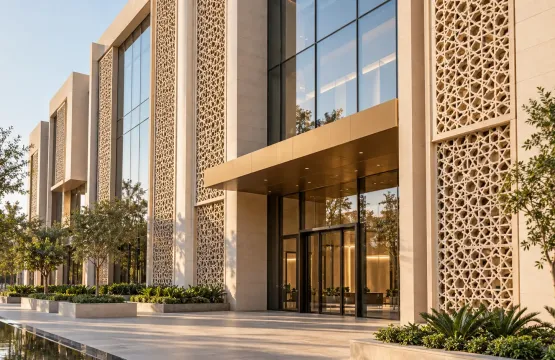
Jali screens have appeared on some of India's most significant recent architecture - not as a decorative reference to heritage but as a genuine performance and identity element on buildings designed to last generations. The material that is making this possible at the highest level of quality is UHPC - Ultra High-Performance Concrete.
At DECO we manufacture UHPC Jalis for landmark buildings across India. This guide explains what UHPC brings to Jali screen specification that no other material can match - and why architects working on significant projects are increasingly choosing UHPC over GRC for their most demanding Jali applications.
What Makes a Landmark Building Different from a Standard Commercial Project
The distinction between a landmark building and a standard commercial project is not just about scale or budget. It is about the level of scrutiny the building will face - from the client, from the public, from the architectural press and from the building's own users over decades of occupation.
On a landmark building every visible element is evaluated more carefully. The Jali screen that wraps a premium hotel tower or defines the entrance of a cultural institution will be photographed, published and studied. The quality of the pattern edge at close range. The consistency of the surface finish across hundreds of panels. The way light moves through the Jali at different times of day. These are details that matter enormously on landmark buildings and that separate a genuinely excellent Jali specification from an adequate one.
This is the environment in which UHPC Jalis - manufactured by DECO to the standards that landmark projects demand - consistently outperform every other Jali screen material available in India today.
Why UHPC Jali Sets the Standard for Landmark Architecture
Pattern Resolution That No Other Material Matches
The defining property of UHPC for Jali screen applications is its ability to reproduce fine pattern geometry with a resolution that GRC and standard concrete cannot approach. The dense, low water-cement ratio mix of UHPC fills moulds completely - capturing sharp edges, fine radii and complex pattern geometries with a precision that reads clearly at close inspection range.
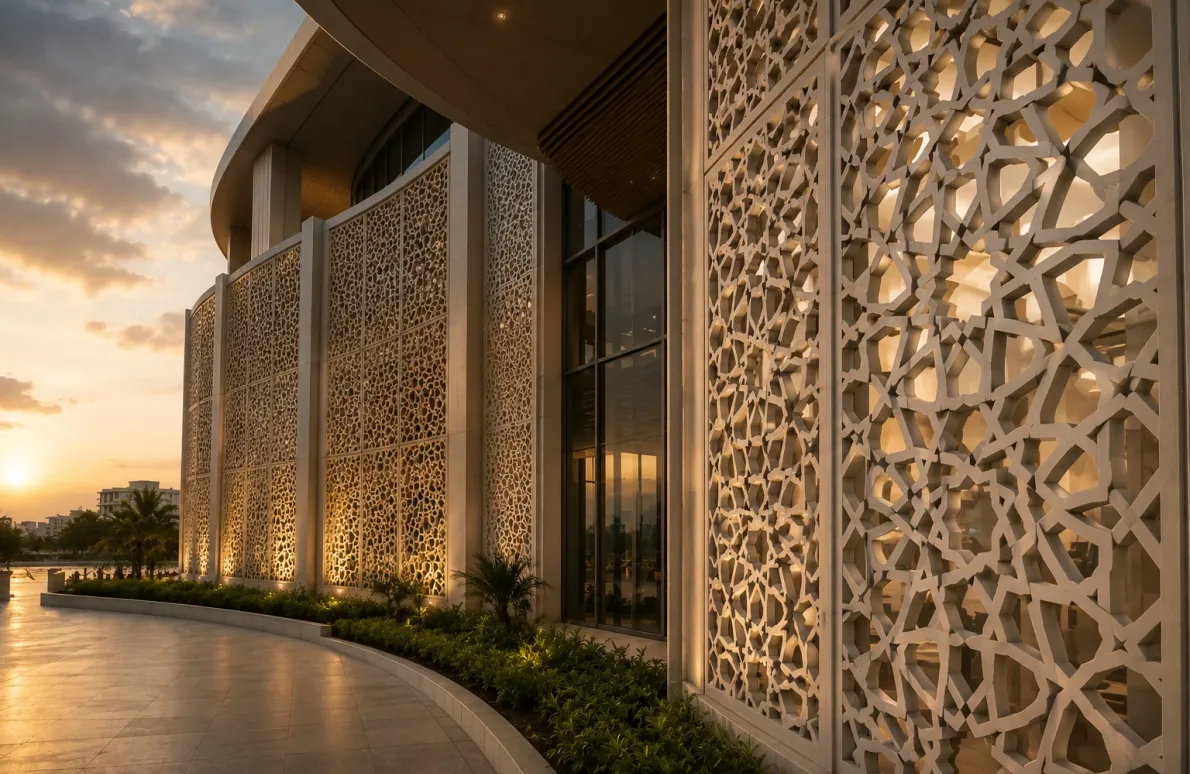
On a landmark building where the Jali pattern is a signature design element - a custom geometry developed by the architect specifically for this project - the difference between a UHPC Jali and a GRC Jali in terms of pattern edge quality is visible and significant. DECO UHPC Jalis hold the pattern as designed. The edge is sharp. The depth of the cutout is consistent. The surface reads at close range exactly as the architect intended.
Surface Quality That Holds Over Time
UHPC has an extremely low porosity - significantly lower than GRC or standard concrete. For a Jali screen that will be on a landmark building for thirty or forty years, this matters enormously. The surface of a DECO UHPC Jali does not absorb dust, pollutants or moisture in the way that more porous materials do. It stays cleaner for longer. It does not develop the biological growth - the algae and lichen that dulls the surface of less dense materials over time in Indian outdoor conditions.
On a landmark building in a major Indian city - Mumbai, Delhi, Bengaluru, Chennai - where air quality and surface pollution are real considerations, the long-term surface performance of UHPC Jali panels is a significant advantage that architects and developers are increasingly factoring into their specification decisions.
Structural Performance in the Thinnest Sections
UHPC achieves its structural performance in sections thinner than any other concrete-based Jali material. DECO UHPC Jali panels can be manufactured with section thicknesses and between-opening widths that GRC cannot achieve without compromising structural integrity. For landmark building facades where the Jali design calls for maximum visual delicacy - the finest possible sections between pattern openings - UHPC is the only material that delivers this without structural compromise.
This thin section capability also reduces the visual mass of the Jali screen from the exterior. A UHPC Jali on a landmark facade has a lightness and refinement that heavier section GRC Jalis cannot match - and on buildings designed to be admired from the street, that visual quality is exactly what the design intent requires.
Consistency Across Large Facade Areas
Landmark buildings are large. A Jali screen that wraps a significant portion of a tower facade might involve hundreds of individual panels manufactured over weeks of production. The consistency of UHPC manufacturing - the dimensional accuracy of each panel, the surface finish quality, the color consistency from batch to batch - is critical to the final result reading as a unified design statement rather than a collection of slightly varying panels.
DECO's UHPC Jali manufacturing process includes rigorous quality control at every production stage - mould inspection, mix consistency verification, surface finish review and dimensional checking before any panel leaves the factory. This process consistency is what landmark building specifications demand and what DECO delivers.
Design note: UHPC Jali panels from DECO are available in custom openness ratios calculated to meet both the design intent and the energy performance requirements of the facade - combining visual resolution with measurable solar shading performance on landmark building elevations.
Where DECO UHPC Jalis Are Being Specified in India
The project types where DECO UHPC Jalis are most commonly specified reflect the landmark building category directly.
- Five star hotel towers - facade Jali screens where surface quality and pattern resolution are evaluated by international guests and architectural clients
- Corporate headquarters for major Indian and multinational companies - entrance and facade Jali elements that carry brand identity through material quality
- Airport terminals and transit infrastructure - large scale Jali screens where pattern consistency across enormous facade areas is the critical specification requirement
- Cultural institutions - museums, art galleries, performance venues where the Jali is a design statement as much as a functional facade element
- Premium residential towers - facade and balcony Jali screens on developments where the building is a landmark in its neighbourhood context
DECO works with architects and facade engineers on these projects from the earliest design stage - supporting pattern development, structural coordination, sample production and manufacturing through to installation. The level of collaboration that landmark Jali projects require is built into DECO's project process.
A Brief Note on GRC and FRP Jali
For projects where the specification requirements of a landmark building are not the driving criteria - standard commercial facades, residential developments, interior applications - DECO manufactures Jali screens in GRC and FRP. GRC Jali delivers excellent performance and design quality for the majority of commercial Jali applications across India. FRP Jali is the right choice where weight is the primary constraint. UHPC Jali is specified when the project demands the highest surface quality, finest pattern resolution and the longest maintenance-free performance available from any manufactured Jali screen material in India today.
Frequently Asked Questions
Q1. What is the difference between UHPC Jali and GRC Jali for landmark building facades?
UHPC Jali from DECO offers significantly finer pattern resolution, higher surface quality and greater structural performance in thinner sections than GRC Jali. The denser UHPC mix reproduces mould detail with a precision that reads at close inspection range - critical on landmark buildings where the Jali screen is a signature design element evaluated by discerning clients, users and architectural press. GRC Jali is the right choice for standard commercial applications. UHPC Jali is specified when the project demands the highest available quality.
Q2. Is DECO a UHPC Jali manufacturer in India?
Yes. DECO manufactures UHPC Jalis for landmark buildings across India - working with architects and facade engineers from pattern development through to manufacturing, quality control and delivery. DECO's UHPC Jali manufacturing process includes rigorous quality control at every production stage to ensure the pattern resolution, surface finish and dimensional consistency that landmark building specifications require.
Q3. Can DECO manufacture UHPC Jalis in fully custom patterns for landmark projects?
Yes. Every DECO UHPC Jali project starts from the architect's custom pattern design - not from a standard catalogue. DECO develops precision moulds from the approved pattern geometry and produces physical sample panels for design team approval before full production begins. Custom pattern geometry, openness ratio, panel dimensions and surface finish are all specified per project.
Q4. How does UHPC Jali perform on landmark buildings in Indian outdoor conditions over time?
DECO UHPC Jali screens are manufactured for long term exterior performance in Indian conditions - monsoon rainfall, high UV, humidity and coastal salt air where relevant. The extremely low porosity of UHPC prevents moisture absorption, surface staining and biological growth that affects more porous materials over time. Stainless steel fixings are used for all exterior installations. UHPC Jali screens on landmark buildings maintain their pattern resolution and surface quality with routine cleaning maintenance only - no periodic surface treatment or recoating required.
Q5. What is the typical lead time for DECO UHPC Jali panels on a landmark project?
Lead time for DECO UHPC Jali panels on landmark projects depends on pattern complexity, mould fabrication requirements and total panel quantity. For most landmark Jali projects, DECO works to a 10 to 14 week lead time from final pattern approval and sample sign-off. Early engagement with DECO at the design development stage - before facade drawings are finalised - allows manufacturing to be programmed in line with the project's installation schedule without creating programme pressure.