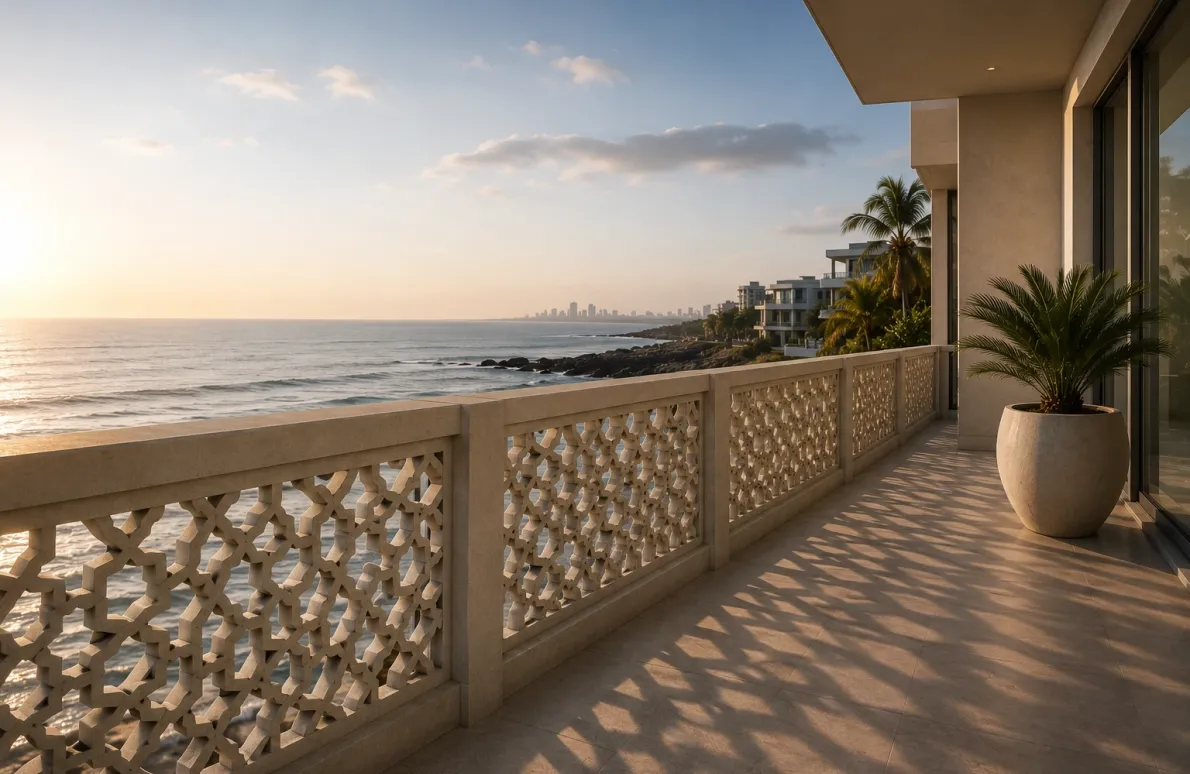
Anyone who has managed a coastal building in India for more than five years will tell you the same thing. Metal railings look good on handover day. By year three the rust patches start appearing at the welded joints. By year six you are repainting entire sections. By year ten you are having a serious conversation about replacement. This is not a maintenance failure. It is a material specification problem — and GRC railing is the solution that more architects and developers are arriving at.
India's coastline stretches across some of the country's most active construction markets — Mumbai, Goa, Chennai, Kochi, Visakhapatnam, Mangaluru. Hotels, residential towers, commercial complexes and resort developments line these coastlines and all of them face the same challenge. Salt air is aggressive. It finds every weakness in a metal railing system — a scratch in the coating, a gap at a fixing point, a poorly sealed weld — and it works from there.
At DECO we manufacture architectural concrete railings in GRC for commercial and residential buildings across India. This blog explains why GRC railing consistently outperforms metal on coastal buildings — and what architects and builders need to know when specifying railings for projects near the sea.
What Salt Air Actually Does to Metal Railings
Salt air corrosion is not a slow, gradual process that you can manage easily. It is an accelerating one. Once rust establishes at a point — a joint, a fixing hole, a surface scratch — it spreads beneath the coating invisibly. By the time the rust is visible on the surface the structural cross section at that point has already been compromised.
On a coastal building the most vulnerable points in a metal railing system are exactly where the most stress concentrates. The base plate fixing — where the railing post meets the structure — sits in a pool of water every monsoon and is constantly exposed to salt spray. Welded joints accumulate moisture in the surface irregularities that welding creates. The cut ends of metal sections where the protective coating is thinnest or absent are the entry points for corrosion that then travels along the section beneath the surface.
Even stainless steel — often specified as the premium coastal solution — is not immune. In high chloride environments like seafront locations, crevice corrosion in stainless steel connections is a known failure mode. Maintenance costs for stainless steel railing systems on coastal buildings are lower than mild steel but they are not zero — and stainless steel carries a significantly higher initial cost that is not always reflected in the specification decision.
Why GRC Railing Is the Right Answer for Coastal Buildings
GRC — Glass Reinforced Concrete — eliminates the fundamental vulnerability that makes metal railings problematic on coastal buildings. There is no ferrous metal in a GRC railing element. The material itself does not corrode. Salt air, moisture and the chemical environment of a coastal location simply do not affect GRC in the way they affect steel or aluminium.
No Corrosion — By Material Design
A DECO GRC railing on a seafront hotel in Goa and the same railing on an inland office in Pune will perform identically over twenty years. The coastal environment creates no additional degradation mechanism for GRC. This is not a coating or a surface treatment that can be scratched or worn away. It is the fundamental chemistry of the material — and it does not change over time.
Stainless Steel Fixings as Standard
The one point where metal does appear in a DECO GRC railing installation is at the fixing connections — and DECO specifies stainless steel fixings as standard for all exterior applications. Stainless steel at the fixing points, combined with GRC at the railing elements themselves, creates a system where corrosion has no pathway to establish and spread. This is the combination that gives DECO GRC railings their long term coastal performance advantage.
Surface Quality That Does Not Deteriorate
Metal railings on coastal buildings require periodic repainting or recoating to maintain their appearance. The coating is the barrier between the metal and the coastal environment — and it degrades. DECO GRC railings do not have a coating that can degrade. The surface finish is integral to the material. It does not peel, fade or require reapplication. The railing that looks clean on installation day still looks clean fifteen years later with only routine cleaning maintenance.
Custom Profiles for Coastal Architecture
Coastal commercial buildings — hotels, resorts, waterfront developments — often have specific aesthetic requirements for their railing profiles. The building's design language, the visual relationship between the railing and the sea view, the way the railing reads against a bright coastal sky — these are real design considerations that a standard metal railing section cannot always address. DECO manufactures GRC railings in fully custom profiles developed from the architect's drawings — giving design teams the freedom to specify exactly the railing character the project requires.
Specification note: For coastal buildings within 500 metres of the sea — particularly in high wave action zones — DECO recommends GRC railing with full stainless steel fixing systems and a review of base plate drainage detail to prevent water pooling at connection points.
What DECO Brings as a GRC Railing Manufacturer
Working with an experienced GRC railing manufacturer matters on coastal projects because the specification decisions that determine long term performance — mixing specification, surface sealer selection, fixing design, joint detailing — are made at the manufacturing stage, not on site.
DECO's GRC mix specification for exterior coastal applications uses alkali-resistant glass fibres, a low water-cement ratio and a surface treatment designed for high humidity and salt air exposure. Every DECO GRC railing element for coastal use is manufactured to a specification that accounts for the specific environmental demands of the installation location.
DECO also provides fixing design support — working with the project's structural engineer to detail base plate connections, core fill systems and movement joint locations that are appropriate for the coastal environment. This coordination at the design stage prevents the connection failures that are the most common cause of long term railing performance problems on coastal buildings.
A Brief Note on UHPC and FRP Railings
For premium coastal projects requiring the finest surface quality and most slender profiles — DECO also manufactures railings in UHPC. For applications where absolute minimum weight is the priority — interior balustrades, lightweight canopy railings — FRP railing elements are available. For the majority of exterior coastal commercial and residential railing applications across India, GRC delivers the right combination of corrosion resistance, design flexibility, structural performance and value over the building's full life.
Frequently Asked Questions
Q1. Why does GRC railing outperform metal railing on coastal buildings?
GRC railing contains no ferrous metal and is completely unaffected by salt air, coastal moisture and the chemical environment that causes metal railings to corrode. DECO GRC railings combined with stainless steel fixings create a railing system with no corrosion pathway — eliminating the fundamental failure mechanism that makes metal railings problematic on coastal buildings over time.
Q2. Does DECO manufacture GRC railings in custom profiles for coastal architecture?
Yes. DECO manufactures architectural concrete railings in fully custom profiles developed from the architect's drawings. Classical balustrade sections, contemporary geometric profiles and bespoke designs referenced to the building's coastal architectural character are all achievable. DECO produces sample sections for design team approval before full production begins.
Q3. What maintenance does a DECO GRC railing require on a coastal building?
Routine cleaning is the primary maintenance requirement for DECO GRC railings in coastal locations. The surface finish is integral to the material and does not require periodic repainting, recoating or sealing. Stainless steel fixings used as standard in all exterior DECO GRC railing installations eliminate the corrosion maintenance that metal fixing systems require in coastal conditions.
Q4. How close to the sea can DECO GRC railings be installed?
DECO GRC railings are suitable for coastal installation including seafront locations with direct wave spray exposure. For buildings within 500 metres of the sea DECO recommends a coastal-specific GRC mix specification, full stainless steel fixing systems and a reviewed base plate drainage detail. DECO's technical team provides location-specific specification guidance for coastal projects at the design stage.
Q5. What is the lifespan of DECO GRC railings on coastal commercial buildings?
DECO GRC railings are designed for the full lifespan of the building — typically 25 to 30 years or more. In coastal environments the material performance advantage of GRC over metal becomes more pronounced over time as metal systems require increasing maintenance intervention while GRC systems continue to perform with routine cleaning only. The long term lifecycle cost of DECO GRC railings is significantly lower than metal alternatives on coastal buildings.