GRC Artcraft for Commercial Buildings - Where Texture, Detail and Structural Performance Meet
Walk into any well-designed commercial building completed in India recently - a hotel, a corporate office, a cultural institution - and pay attention to the details that make it feel finished. The cornice line that defines the ceiling edge. The arched entrance that gives the lobby its sense of arrival. The textured wall panel that makes you want to look closer. These elements are increasingly being manufactured in GRC - and for good reason.
Decorative architectural elements have always been part of serious commercial design. What has changed is the material they are made from. Stone carving is expensive and slow. Cast plaster deteriorates in Indian climate conditions. Standard concrete lacks the detail resolution that ornamental work demands.
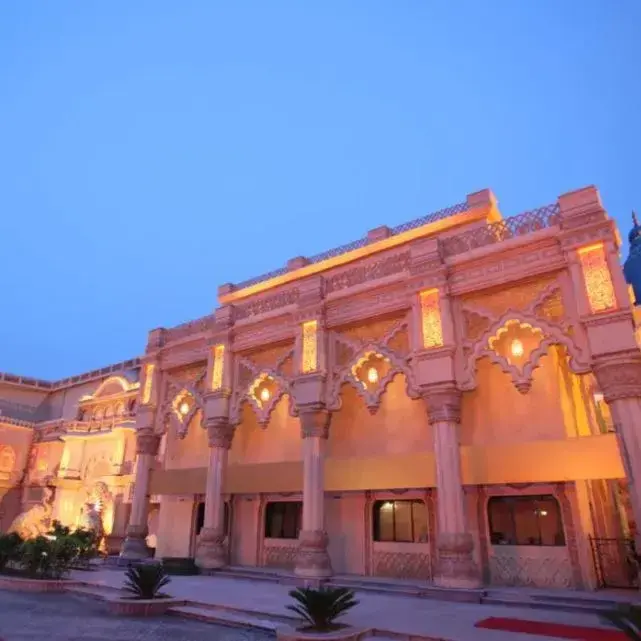
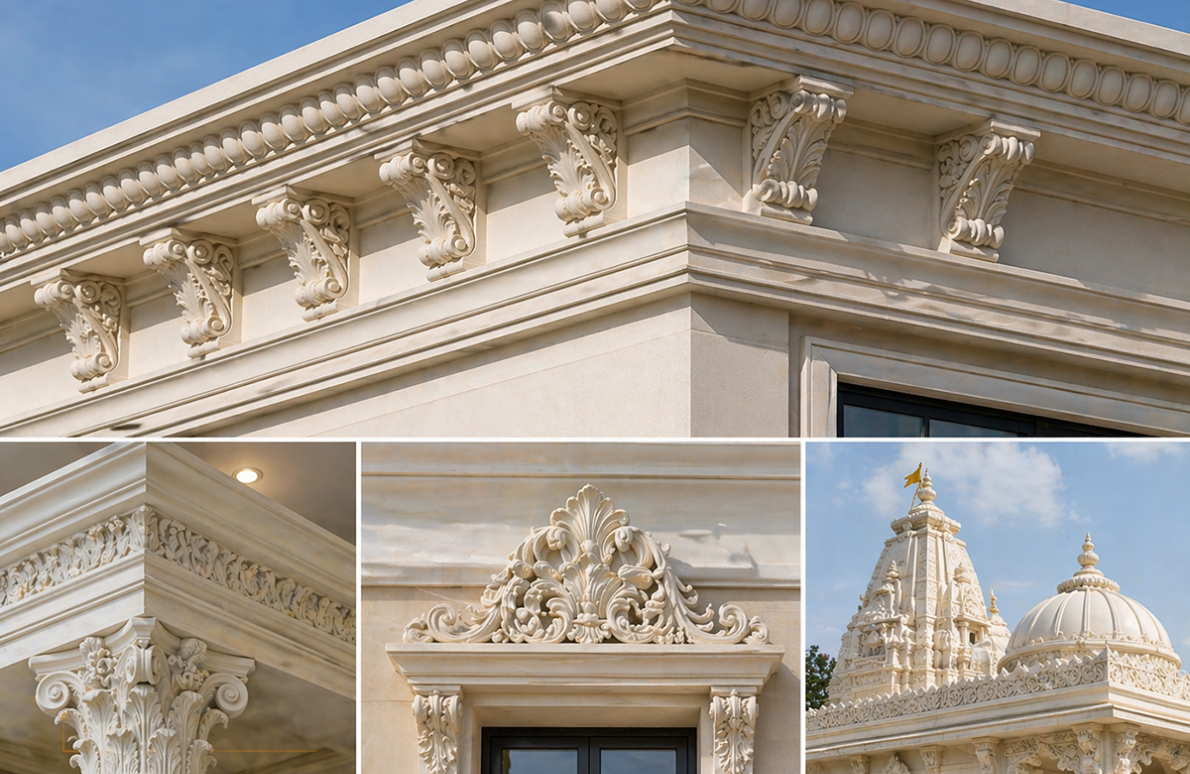
GRC - Glass Reinforced Concrete - sits in a different position. It combines the visual weight and permanence of concrete with a manufacturing precision that makes complex ornamental forms practical on real commercial projects. At DECO we manufacture GRC artcraft for commercial buildings across India - cornices, arches, relief panels and integrated facade art features designed to carry architectural identity rather than just cover surfaces.
Why GRC Works for Ornamental Architectural Elements
The material properties of GRC make it genuinely well suited to ornamental and relief work - not just as a lighter alternative to concrete but as a material that actively enables detail quality that other options cannot match.
GRC reproduces mould geometry with precision. Sharp arrises stay sharp. Curved profiles hold their radius consistently across multiple panels. Fine surface relief reads at close range exactly as it was designed. This matters enormously for elements like GRC cornice profiles and architectural arches where the quality of the edge and the consistency of the profile across a long run or repeated opening directly determines how the finished building reads.
The reduced weight compared to conventional concrete is equally important practically. A GRC cornice profile that visually matches a precast concrete equivalent can weigh 60 to 70 percent less. On a large commercial building where the cornice runs across an entire facade elevation - or where architectural arches frame multiple openings across several floors - that cumulative weight saving affects the fixing design, the structural loading and the installation programme in ways that matter to the builder and the engineer, not just the architect.
GRC Cornice - Getting the Detail Right at Building Scale
The cornice is one of those elements that defines a building's character from the street. It is the transition between the facade and the roofline - and when it is done well, it gives a commercial building a finished, considered quality that generic flat parapets simply cannot deliver.
India's temple architecture has some of the most elaborately detailed cornice profiles in the world. The tiered horizontal mouldings of a South Indian temple mandapa, the projecting chajja lines of a North Indian shikhara — these are cornice traditions that have influenced Indian commercial and institutional architecture for centuries. What DECO does is bring that level of profile complexity into GRC manufacturing for today's commercial projects.
DECO manufactures GRC cornice profiles for commercial buildings in custom sections developed from the architect's drawings. The GRC casting process allows complex cornice profiles - with multiple projections, shadow lines, and surface mouldings - to be produced consistently across long runs without the variation that site-applied plaster or cut stone creates.
For heritage adjacent projects and classical revival commercial buildings - a growing trend in India in 2026 - the GRC cornice is one of the most practical ways to achieve an authentic ornamental profile at the scale and pace that commercial construction demands. DECO works with architects from profile development through to installation coordination, ensuring the cornice section integrates correctly with the primary facade system and the parapet waterproofing detail.
Specification note: GRC cornice profiles should be specified with movement joints at regular intervals - typically every 3 to 4 metres - to accommodate thermal expansion without cracking at panel joints. DECO's technical team provides joint spacing and detail recommendations for each project.
Architectural Arches - Form, Structural Logic and Material
The arch has returned strongly to Indian commercial architecture in 2026. Hotel entrances, retail frontages, office lobby portals, courtyard openings - architectural arches are appearing on projects where a decade ago a flat headed opening would have been the default.
GRC is well suited to arch manufacture for several reasons. The material can be cast to curved geometry with precision - the intrados profile, the keystone detail, the extrados line - all hold accurately in GRC in a way that is difficult to achieve consistently with in-situ concrete or stone. Voussoir style arch panels from DECO can be manufactured as a coordinated set - each panel profiled to the correct angle for the overall arch geometry - and installed as a system with concealed stainless steel fixings.
For larger span architectural arches on commercial building facades, DECO works with the structural engineer to confirm the fixing system and load transfer design before manufacturing. GRC arch elements are non-structural in most facade applications - they express the arch form while the primary structure handles the loads - but the connection between the GRC and the substrate has to be properly engineered for wind load and dead load transfer.
Architectural ArtCraft Facade - Bringing It All Together
The most considered commercial buildings use GRC not just for isolated elements but as a coordinated architectural artcraft facade strategy - where cornice, arches, relief panels and surface texture work together as a single design language across the building exterior.
DECO works with architects on projects where this level of facade coordination is brief. The manufacturing consistency of GRC makes it possible to produce multiple element types - cornice profiles, arch voussoirs, column cladding, relief panels - from a coordinated material and finish specification. Every element reads as part of the same family because it comes from the same material system, the same finish process and the same quality of detail.
This is where the architectural artcraft facade conversation moves beyond individual product specification into genuine design collaboration. DECO's role in these projects is to translate the architect's design intent into manufactured elements that perform structurally, hold their quality over time and install efficiently within the construction programme.
A Brief Note on UHPC and FRP
For projects where even finer profile detail or greater structural slenderness is required - DECO also manufactures ornamental facade elements in UHPC. FRP is available for lightweight interior decorative applications. For the majority of exterior commercial artcraft facade work across India - where weather resistance, detail resolution, structural reliability and installation practicality all matter together - GRC remains the most widely specified and most practical material choice.
Frequently Asked Questions
Q1. Can DECO manufacture GRC cornice profiles in custom sections?
Yes. DECO manufactures GRC cornice profiles in fully custom sections developed from architect's drawings or profile templates. Complex sections with multiple projections, shadow lines and surface mouldings are achievable. DECO produces a sample section for design team approval before committing to full run production - ensuring the profile matches the design intent accurately before installation.
Q2. How are DECO GRC architectural arches fixed to a commercial building facade?
DECO GRC arch elements are fixed using stainless steel fixings cast into the panels during manufacture. For voussoir style arch systems, each panel is individually fixed to the substrate with fixings designed to transfer dead load and wind load back to the primary structure. Fixing design is coordinated with the structural engineer before manufacturing. All exterior fixings are stainless steel to prevent corrosion staining on the GRC surface.
Q3. What surface finishes are available for DECO GRC ArtCraft facade elements?
DECO GRC cornice, arch and relief artcraft elements are available in smooth, fine textured, sand faced and custom pigmented finishes. Color is introduced through integral pigmentation in the GRC mix - running through the full material depth rather than as a surface coating. This means the finish does not chip, peel or fade over time. Custom color matching to the project's material palette is available for larger orders.
Q4. Are DECO GRC ArtCraft facade elements suitable for coastal locations in India?
Yes. DECO GRC artcraft facade elements are manufactured for Indian outdoor conditions including coastal salt air, monsoon rainfall and high UV exposure. The material contains no ferrous metal and is unaffected by moisture and salt air. Stainless steel fixings are used for all exterior applications. DECO GRC facade elements installed in coastal cities including Mumbai, Chennai and Kochi maintain their structural and visual performance without corrosion related maintenance.
Q5. Are DECO GRC ArtCraft elements suitable for temple restoration and heritage projects?
Yes. DECO GRC ArtCraft is well suited to temple restoration, heritage building renovation and cultural institution projects where ornamental elements need to be replaced or replicated. GRC can reproduce traditional moulding profiles, relief patterns and arch forms with the precision that heritage work demands - at significantly lower cost and weight than stone carving. DECO works with conservation architects and heritage consultants on these specialist projects.
Q6. When in the design process should DECO be engaged for GRC ArtCraft facade elements?
Early engagement produces significantly better outcomes. Ideally DECO should be involved at design development stage - before construction drawings are finalised - so that profile sections, panel sizes, fixing coordinates and movement joint locations can be integrated into the facade drawings from the start. Late specification of GRC ArtCraft elements creates programme pressure and limits design options. DECO offers design consultation at no cost for projects at early specification stage.