Walk through any well designed public space - a corporate campus, a hotel courtyard, a residential podium garden or a city plaza - and pay attention to the benches. Chances are they are not what they look like. What appears to be solid heavy concrete is very likely GRC or UHPC. And there are good reasons for that.
The outdoor bench is one of those elements that gets specified late in a project and often without enough thought. It is treated as a finishing detail rather than a design decision. But the material a bench is made from directly affects how long it lasts, how much it costs to maintain, how much load it adds to the surface it sits on and whether it still looks good five years after installation.
At DECO we manufacture architectural furniture - including outdoor benches and seating - in GRC and UHPC for public spaces, commercial developments and landscape projects across India. This is a straightforward look at why these materials are becoming the preferred choice over traditional concrete for outdoor furniture.
The Problem With Traditional Concrete Benches
Traditional concrete benches have been the default choice for public spaces for decades. They are heavy, they look permanent and they are cheap to produce. But those qualities come with real drawbacks that show up over time.
Weight is the first issue. A solid precast concrete bench is extremely heavy. On a rooftop garden, a podium level public space or an elevated plaza - that weight adds to the structural dead load of the slab. On large projects with many benches and outdoor furniture pieces, this accumulates into a structural design consideration that drives cost.
Surface quality is the second issue. Standard concrete is porous. Over time it stains, develops biological growth - moss, algae, watermarks - and the surface deteriorates in ways that are difficult and expensive to reverse. A concrete bench that looked clean and solid on day one can look tired and neglected within three to four years in Indian outdoor conditions without regular maintenance.
Design limitation is the third issue. Traditional concrete is difficult to shape into anything other than simple block forms at a reasonable cost. Custom profiles, curved forms, integrated planting elements, fine surface detail - these are expensive and inconsistent in standard precast concrete.
Why GRC Outdoor Furniture Is a Better Answer
GRC - Glass Reinforced Concrete - was developed specifically to solve the problems that traditional concrete creates in thin section and decorative applications. As a concrete bench manufacturer working with GRC, DECO produces benches that look like solid concrete but weigh a fraction of the equivalent precast piece.
The glass fibres in GRC give the material tensile strength that standard concrete lacks. This means GRC outdoor furniture can be manufactured with thin walls - hollow or semi-hollow construction - while maintaining full structural integrity under the loads an outdoor bench faces. A DECO GRC bench that looks identical to a solid precast concrete bench can weigh 60 to 70 percent less.
That weight saving matters practically. It makes installation faster and easier - no heavy lifting equipment needed for standard bench placement. It reduces structural load on elevated surfaces. And it makes repositioning possible if the landscape layout changes after installation.
GRC also takes surface finish better than standard concrete. DECO GRC outdoor furniture is available in smooth, textured, exposed aggregate and custom pigmented finishes. The finish is cast into the material - it does not fade, peel or require reapplication over time the way coated surfaces do.
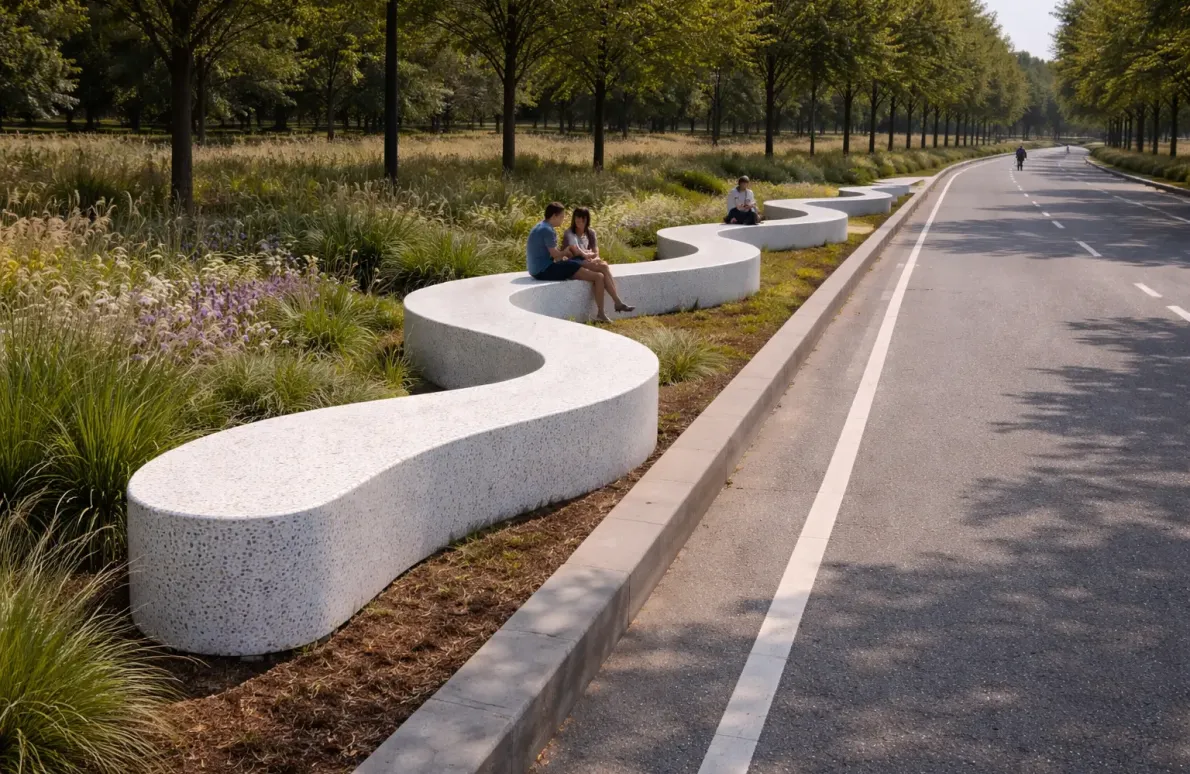
Design note: GRC outdoor furniture can be manufactured in fully custom forms - curved profiles, integrated planter and bench combinations, cantilevered seat elements - at a cost and consistency that standard precast concrete cannot match.
Where UHPC Adds Value for Outdoor Seating
For public space furniture where the design intent calls for something more refined - finer profiles, sharper edges, a surface finish closer to polished stone than cast concrete - UHPC is the material that delivers it.
UHPC outdoor benches from DECO can be manufactured with wall sections significantly thinner than GRC while still meeting the structural requirements of a fully loaded public bench. The surface quality of UHPC is noticeably higher - it has a density and smoothness that reads as premium in a way that standard concrete or even GRC does not quite achieve.
For hotel courtyards, luxury residential developments, corporate headquarters and premium public spaces - where the outdoor furniture is a deliberate part of the design language rather than a standard fitout - UHPC architectural furniture from DECO is the specification that most architects reach for.
UHPC also has extremely low porosity. Staining, biological growth and surface deterioration are significantly less of an issue compared to standard concrete - which matters for public space furniture that gets continuous exposure and heavy use.
Choosing Between GRC and UHPC for Your Project
Both materials are significantly better than traditional concrete for outdoor bench and public space furniture applications. The choice between them comes down to project context.
- Budget conscious projects with large quantities of benches - GRC delivers the best value
- Premium developments where surface quality and fine profiles matter - UHPC is the right specification
- Elevated or rooftop public spaces where load is a structural constraint - both GRC and UHPC outperform traditional concrete significantly
- Custom forms and integrated landscape furniture pieces - GRC offers the most cost-effective manufacturing flexibility
- Coastal locations where long-term surface quality matters - UHPC's low porosity gives it the edge
DECO works with landscape architects, architects and developers at the specification stage to identify which material suits each specific project situation. The right choice is always the one that fits the project's structural conditions, design intent and long-term maintenance expectations together.
Frequently Asked Questions
Q1. What is the weight difference between a DECO GRC bench and a traditional precast concrete bench?
A DECO GRC outdoor bench typically weighs 60 to 70 percent less than a solid precast concrete bench of equivalent size. This is because GRC is manufactured with thin wall construction using glass fibre reinforcement - giving structural strength without the bulk and mass of solid concrete.
Q2. Can DECO manufacture custom shaped outdoor benches in GRC or UHPC?
Yes. DECO manufactures architectural furniture in fully custom forms - curved profiles, integrated planter and bench combinations, cantilevered designs and bespoke dimensions. All pieces are manufactured using custom moulds developed in coordination with the project architect or landscape designer.
Q3. How do GRC outdoor benches perform in Indian monsoon conditions?
DECO GRC outdoor furniture is manufactured for Indian outdoor conditions including monsoon rainfall, high humidity and UV exposure. The material handles these conditions reliably. Properly finished GRC surfaces resist staining and biological growth significantly better than standard concrete - maintaining their appearance with minimal maintenance over time.
Q4. What surface finishes are available on DECO outdoor concrete benches?
DECO GRC and UHPC outdoor benches are available in smooth, lightly textured, exposed aggregate and custom pigmented finishes. Color is introduced through integral pigmentation - running through the full material depth rather than as a surface coating - so the finish does not fade or peel over time.
Q5. Is DECO a concrete bench manufacturer that works on large public space projects?
Yes. DECO manufactures architectural furniture including outdoor benches for public spaces, corporate campuses, hospitality developments and residential projects across India. DECO works directly with project teams from specification through to manufacturing and delivery - including large quantity orders for major landscape and public space projects.