The outdoor bench has not changed much in a hundred years.
A flat seat. A back rest. Four legs. Positioned along a path, beside a water feature or facing a view. It solves the seating requirement - people can sit - but it rarely does anything more than that. On a premium landscape where every other element has been specified with intention and precision, the conventional bench reads as exactly what it is - a generic product selected from a catalogue rather than a considered landscape decision.
This is why landscape architects and developers working on premium resort gardens, corporate campuses, luxury residential developments and high-end public spaces across India are making a different choice. Not a better bench. A fundamentally different approach to landscape seating - one that starts with the landscape itself rather than with the furniture catalogue.
Architectural pebble seating is that different approach. And DECO's GRC Architectural Pebbles are at the centre of one of the most interesting shifts in premium landscape specification happening in India right now.
Pebble Seating vs Conventional Benches - At a Glance
The Problem With Conventional Benches in Premium Landscapes
Premium landscape design has evolved significantly in the last decade. The approach to planting, hardscape, water features and lighting on high-end residential, hospitality and commercial landscape projects is increasingly sophisticated - informed by biophilic design principles, materiality thinking and a genuine understanding of how people inhabit outdoor spaces.
The seating specification has not kept pace.
The Generic Catalogue Problem
Most conventional outdoor benches are selected from manufacturer catalogues - standard profiles, standard dimensions, standard finishes. On a landscape where every other element has been custom specified, a catalogue bench creates an immediate visual discontinuity. It reads as selected rather than designed. And on a premium project where the landscape is a significant part of the value proposition - a resort, a luxury residential development, a premium corporate campus - that disconnect between the landscape quality and the furniture quality is noticed.
The Material Performance Problem
Conventional outdoor bench materials have consistent failure modes that premium landscape managers deal with repeatedly. Metal benches - steel or aluminium - corrode at welds and joints in Indian outdoor conditions, particularly in coastal and high humidity environments. Timber benches require periodic oiling, staining or painting to maintain their appearance outdoors - a maintenance overhead that commercial landscape budgets cannot realistically sustain on any scale. Standard concrete benches are durable but heavy, visually utilitarian and difficult to reposition as the landscape use patterns change over time.
The Single Function Problem
A conventional bench does one thing. It provides seating. On a premium landscape where space is designed with multiple purposes in mind - where an element might serve as a zone divider, a planting anchor and a seating element simultaneously - a single-function bench is an inefficient use of the landscape budget and the landscape area it occupies.
The question that landscape architects are increasingly asking is not which bench to specify but whether a bench is the right answer to the seating requirement at all. Pebble seating starts from the landscape design intent rather than from the furniture catalogue - and that shift in starting point produces a fundamentally different outcome.
What Pebble Seating Does Differently
Form That Belongs to the Landscape
The defining characteristic of architectural pebble seating is that its form comes from nature rather than from furniture manufacturing convention. The rounded, organic profiles of pebble seating elements reference the forms of water-worn stone - forms that exist in riverbeds, on shorelines and in natural landscapes across India. These forms have an inherent rightness in outdoor settings that the rectilinear geometry of conventional bench design does not.
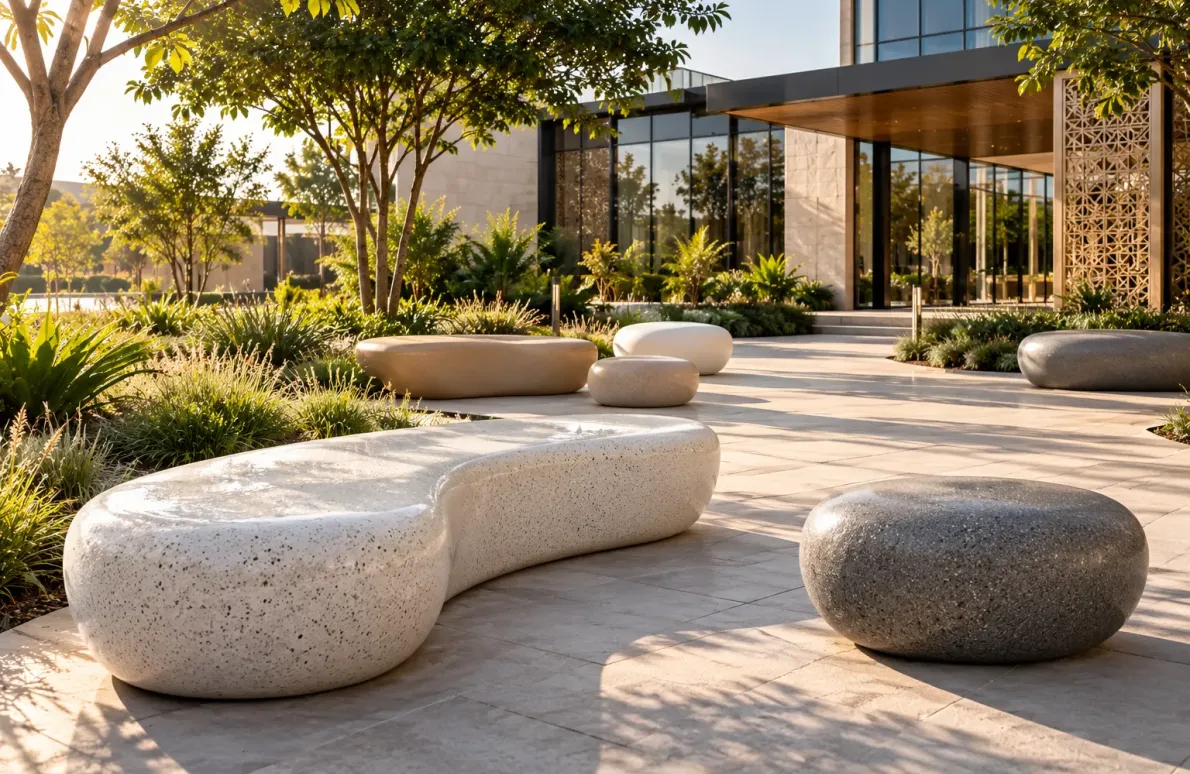
When DECO Architectural Pebbles are placed in a resort garden, a corporate campus courtyard or a premium residential landscape, they read as elements that belong in that landscape - not as furniture that has been placed in it. This distinction sounds subtle but its visual effect is significant. The landscape reads as more considered, more integrated and more deliberately designed when the seating elements reinforce its natural character rather than interrupting it.
Multiple Functions in a Single Element
The most significant practical advantage of architectural pebble seating over conventional benches is the integration of multiple landscape functions in a single element. DECO Architectural Pebbles combine seating and planting in forms that cannot be separated - the planting emerges from the pebble form and the seating is part of that same sculptural whole.
This integration removes the visual clutter that separate bench and planter elements create in landscape settings. Instead of a bench positioned beside a planter - two separate elements occupying space and creating visual complexity - a single pebble seating element provides both functions within a unified sculptural form. The landscape simplifies. The space reads as more resolved. And the eye moves through the landscape without the visual interruptions that multiple separate elements create.
Arrangement as Landscape Decision
A conventional bench has a fixed orientation - it faces a direction, it sits against a path edge or beside a feature, and its position in the landscape is determined by the path it serves. Pebble seating can be arranged in groupings that create landscape spaces rather than simply occupy them.
A cluster of DECO Architectural Pebbles of different sizes creates an informal gathering zone - a landscape destination rather than a rest stop along a path. The arrangement can be designed to create a partially enclosed seating area, to define the edge of a planting zone, to create a focal point in a larger open space or to establish a conversation cluster for two or three people in an outdoor breakout area. The pebble grouping is a landscape design decision with spatial consequences - not just a seating provision.
Why GRC Is the Right Material for Architectural Pebble Seating
The organic, rounded form of architectural pebble seating places specific demands on the material it is made from - demands that conventional bench materials cannot meet.
Form Precision in Curved Geometry
The smooth, continuous curves of pebble seating can only be produced consistently in a cast material. GRC - Glass Reinforced Concrete - is cast in precision moulds that reproduce complex curved geometry with surface consistency that reads as sculpted rather than manufactured. Every DECO Architectural Pebble from the same mould is dimensionally identical - the curves are consistent, the surface quality is uniform and the form reads as resolved from every viewing angle.
Surface Quality That Elevates the Landscape
The surface of DECO Architectural Pebbles is manufactured with low porosity that resists staining, biological growth and the surface soiling that accumulates on outdoor seating in Indian outdoor conditions. The finish options - Concrete, Terrazzo, Travertine, Sandstone and Granite - are achieved through integral pigmentation and manufacturing process rather than surface coating, meaning the finish runs through the full material depth and cannot chip, peel or fade over the life of the landscape.
This surface quality matters on premium landscapes where the seating elements are evaluated at close inspection range by guests and residents who expect the same standard of finish they experience in the interior spaces of the resort or residence.
Durability Without Maintenance Overhead
GRC pebble seating is manufactured for the full life of the outdoor space it serves. No rust. No rot. No periodic painting, oiling or surface treatment required. In Indian outdoor conditions - monsoon rainfall, intense UV, high humidity and in coastal locations, persistent salt air - DECO GRC Architectural Pebbles maintain their surface quality and structural integrity with routine cleaning as the only maintenance requirement.
For facilities management teams on premium resort and residential developments where outdoor furniture maintenance is a recurrent operational cost, this low maintenance performance over decades is a significant lifecycle cost advantage over conventional bench materials.
Where DECO Architectural Pebbles Are Replacing Conventional Benches
Frequently Asked Questions
Q1. What are DECO Architectural Pebbles made from?
DECO Architectural Pebbles are manufactured from Glass Reinforced Concrete - GRC. The alkali-resistant glass fibre reinforcement gives GRC the tensile strength to achieve smooth curved forms in thin wall construction - producing pebble seating elements that have the visual presence of solid stone at a significantly lower weight. GRC's low porosity surface resists staining, biological growth and weathering in Indian outdoor conditions without the maintenance that stone or metal alternatives require.
Q2. Can DECO Architectural Pebbles be arranged in custom groupings for specific landscape layouts?
Yes. DECO Architectural Pebbles are designed to work as a landscape system - different sizes and forms grouped in arrangements specific to the landscape space they occupy. DECO works with landscape architects from the design stage to develop pebble groupings that suit the scale, character and use requirements of each specific outdoor space - from intimate resort pool areas to large open plaza environments.
Q3. What surface finishes are available for DECO Architectural Pebbles?
DECO Architectural Pebbles are available in five surface finishes - Concrete, Terrazzo, Travertine, Sandstone and Granite. All finishes are achieved through integral pigmentation and the GRC manufacturing process - running through the full material depth rather than applied as surface coatings. Custom color specifications are available on request. Physical sample pebbles in the specified finish are produced for design team approval before full production on all projects.
Q4. Are DECO Architectural Pebbles suitable for coastal resort and residential landscapes?
Yes. DECO GRC Architectural Pebbles are manufactured with alkali-resistant glass fibres and tested for coastal outdoor conditions - suitable for resort and residential landscape applications in coastal cities and seaside locations across India. The low porosity surface resists salt air, moisture absorption and biological growth that accumulate on more porous materials in coastal environments. Routine cleaning is the primary maintenance requirement in coastal landscape installations.
Q5. Can DECO Architectural Pebbles function as both seating and planters simultaneously?
Yes - this dual function is fundamental to the architectural pebble design concept. DECO Architectural Pebbles integrate seating surfaces and planting volumes in a single sculptural form - the planting emerges from the pebble element and the seating wraps around it within the same unified piece. This integration removes the need for separate bench and planter elements in the landscape - simplifying the material palette, reducing the number of landscape elements and creating a more resolved visual outcome in the outdoor space.
The Landscape Element That Does More
The shift from conventional benches to architectural pebble seating in premium landscapes is not a trend. It is a design maturation - the recognition that outdoor seating on a premium landscape should be as considered as every other element in the space.
Conventional benches solve the seating requirement. Architectural pebbles shape the landscape experience. They create destinations rather than rest stops. They combine seating and planting in forms that belong in outdoor settings. They contribute to the landscape character rather than interrupting it. And in GRC they are manufactured with the surface quality, durability and low maintenance performance that premium outdoor spaces require.
DECO manufactures Architectural Pebbles for premium resort, residential, corporate and public landscape projects across India - working with landscape architects and developers from design concept through to manufactured delivery. The conversation about replacing conventional bench specification with something more considered starts with understanding what the outdoor space is designed to achieve - and what the seating element needs to contribute to that outcome.