The boundary of a commercial property is more than a security feature. It is the first architectural element visitors notice when approaching an office campus, hotel, retail development or institutional building.
A well-designed fence should provide security, define property boundaries and complement the overall architecture. It must also withstand outdoor conditions and remain visually consistent over time.
When selecting fencing materials, architects and developers often compare traditional metal fencing with architectural GRC fences.
Both materials have distinct advantages. Metal fencing is widely used for its structural efficiency and installation flexibility, while GRC fencing offers design customization, solid architectural expression and durable concrete-based surfaces.
Understanding these differences helps project teams select the right fencing system for their commercial developments.
What Are GRC Fences?
GRC stands for Glass Reinforced Concrete, a cement-based composite reinforced with glass fibres.
GRC fence panels are architectural boundary elements designed to combine durability with customized visual detailing. Unlike conventional solid concrete walls, GRC elements can be manufactured with refined profiles, textures and repeated modular patterns.
DECO GRC Fences by The Global Elephant are developed as architectural boundary systems that integrate with commercial landscapes and building elevations.
They are suitable for applications such as:
- Corporate office campuses
- Commercial complexes
- Hotels and resorts
- Premium residential developments
- Institutional campuses
- Retail and mixed-use properties
GRC fencing can provide a more substantial architectural boundary while maintaining consistency with the project's overall design language.
What Is Metal Fencing?
Metal fencing typically uses steel, aluminium or other metal components to create a property boundary.
Common types include welded mesh fences, vertical bar fences, tubular steel fencing and decorative metal panels.
Metal fences are widely used because they can provide strong perimeter protection with relatively slender sections. They are often suitable for industrial properties, warehouses, commercial facilities and locations where open visibility is important.
However, their long-term performance depends on the metal type, protective coating, environmental conditions and maintenance practices.
GRC Fences vs Metal Fencing: Key Differences
| Feature | GRC Fences | Metal Fencing |
|---|---|---|
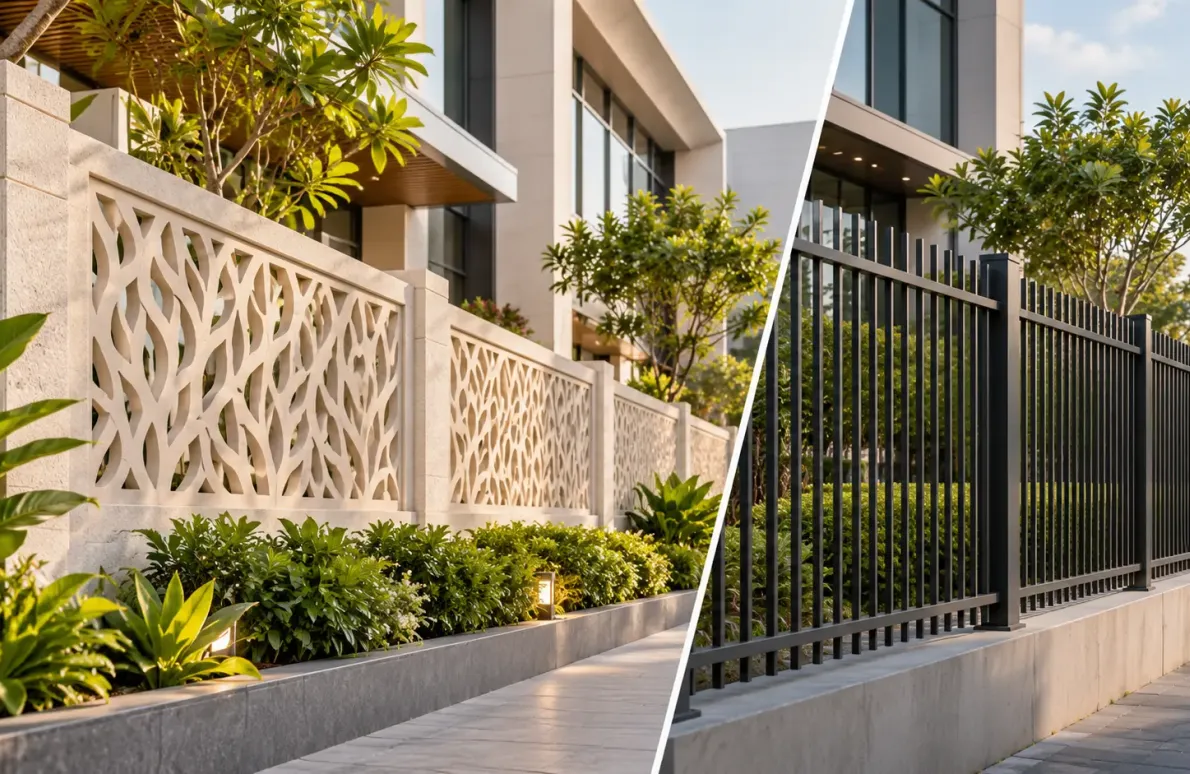
| Appearance | Solid, textured architectural expression | Open, linear or decorative profiles |
| Customization | Moulded patterns, reliefs and finishes | Fabricated shapes, bars and profiles |
| Weight | Lighter than many conventional concrete elements | Generally lighter than comparable solid GRC fencing |
| Corrosion | GRC itself does not rust | Protection depends on material and coatings |
| Maintenance | Cleaning, joint and fixing inspections | Coating, corrosion and fixing inspections |
| Privacy | Can provide greater visual screening | Depends on spacing and panel design |
| Installation | Requires coordinated panels, posts and foundations | Often uses standard posts and modular sections |
| Cost | Custom moulding may increase initial cost | Standard systems may offer lower initial costs |
The right choice depends on the project's security requirements, architectural expectations and maintenance priorities.
1. Durability and Weather Resistance
Commercial fencing in India must withstand sunlight, monsoon rainfall, humidity, dust and pollution.
GRC provides a durable cement-based surface suitable for exterior applications when manufactured and detailed correctly. Unlike exposed steel, the GRC material itself does not rust.
Metal fencing can also offer excellent durability, particularly when appropriate galvanizing, powder coating or corrosion-resistant alloys are specified.
However, damaged protective coatings, poorly treated joints and exposed steel edges can become vulnerable to corrosion, especially in coastal and humid environments.
For both materials, correct installation and periodic inspection are essential to long-term performance.
2. Maintenance Requirements
Maintenance is an important consideration for commercial developments with extensive boundary fencing.
GRC fences generally require periodic cleaning, surface inspection and checks of joints, posts and connections. They do not need corrosion-protection repainting in the same manner as exposed steel fencing.
Metal fences may require coating inspections, occasional repairs or refinishing depending on the material and environment. Well-designed galvanized or corrosion-resistant metal systems can also provide long service life.
For large commercial properties, the comparison should consider maintenance over the entire service life rather than only the purchase price.
3. Architectural Design Flexibility
One of the strongest advantages of GRC fencing is its ability to become part of the architectural design.
GRC can be moulded into customized panels with geometric patterns, relief textures and carefully controlled profiles.
This allows architects to coordinate boundary fencing with building façades, landscape elements, entrance features and exterior finishes.
Metal fencing offers a different design language, with slender vertical members, open geometric patterns and lightweight visual compositions.
For premium developments where a substantial, textured boundary is preferred, DECO GRC Fences provide an architectural alternative to conventional metal systems.
4. Privacy and Security
Commercial properties require different levels of privacy and perimeter protection.
GRC fence panels can provide greater visual screening through solid or partially open designs. This makes them useful for corporate campuses, hospitality developments and properties where privacy is important.
Metal fencing is suitable when visibility through the boundary is desirable. It can be particularly practical for security-monitored perimeters and industrial installations.
Neither material guarantees security by itself. Fence height, panel strength, opening dimensions, anti-climb detailing, posts, foundations and access-control requirements must all be considered.
5. Installation and Structural Considerations
GRC and metal fencing require different installation strategies.
Metal fencing commonly uses posts and prefabricated sections, making standard systems relatively straightforward to install.
GRC fence panels require careful planning of panel dimensions, post spacing, structural support and fixing details.
Although GRC can be lighter than traditional solid concrete fencing, its weight must still be considered during transport, handling and installation.
For commercial boundary systems, wind loads, impact resistance, foundation conditions and movement joints should be reviewed during design.
A well-planned modular system helps maintain alignment and visual consistency across long property boundaries.
6. Cost and Long-Term Value
The initial cost of fencing depends on material, panel dimensions, design complexity, finish, foundations and installation requirements.
Standard metal fencing may offer a more economical solution for basic commercial boundaries.
Custom GRC fencing can involve additional design development and mould manufacturing, particularly when specialized patterns or finishes are required.
However, architectural appearance, maintenance requirements and long-term durability may justify the investment for premium properties.
For developers, the most useful comparison is the total cost of ownership, including installation, maintenance, repairs and eventual replacement.
Where GRC Fencing Works Best
GRC fencing is particularly relevant for projects where the property boundary is expected to contribute to architectural identity.
Corporate campuses: Custom GRC fence panels can establish a consistent design language across the site perimeter.
Hotels and resorts: Textured architectural fencing can support privacy while complementing landscaped environments.
Premium commercial developments: GRC fencing can create refined boundaries that coordinate with façade materials and entrance elements.
Institutional properties: Modular fencing can provide a visually consistent boundary across extensive sites.
Mixed-use developments: GRC panels can connect landscape design, public-facing boundaries and architectural features.
For industrial properties or projects requiring highly open, economical perimeter fencing, metal systems may remain the more practical choice.
Why Consider DECO GRC Fences?
DECO by The Global Elephant offers GRC architectural fencing solutions designed around modular construction, refined surface detailing and project-specific customization.
The range allows architects to explore geometric patterns, surface textures and finishes that complement the main development.
Depending on project requirements, finishes may include sandstone-inspired textures, pigmented surfaces, granite-inspired finishes and other architectural treatments.
This design flexibility makes DECO GRC Fences relevant for commercial projects where the perimeter must contribute to the overall appearance of the property.
Final Thoughts
Choosing between GRC fences and metal fencing depends on the priorities of the commercial development.
Metal fencing remains a practical solution where open visibility, standard installation and cost efficiency are important.
GRC fencing offers a different advantage. It allows property boundaries to become architectural elements through customized patterns, textured finishes, visual screening and coordinated design.
For commercial properties where boundary appearance, privacy and long-term architectural consistency matter, GRC fence panels are worth considering.
Evaluating the fencing system during the early design stage allows architects and developers to balance material performance, security, installation and visual identity before finalizing the property perimeter.