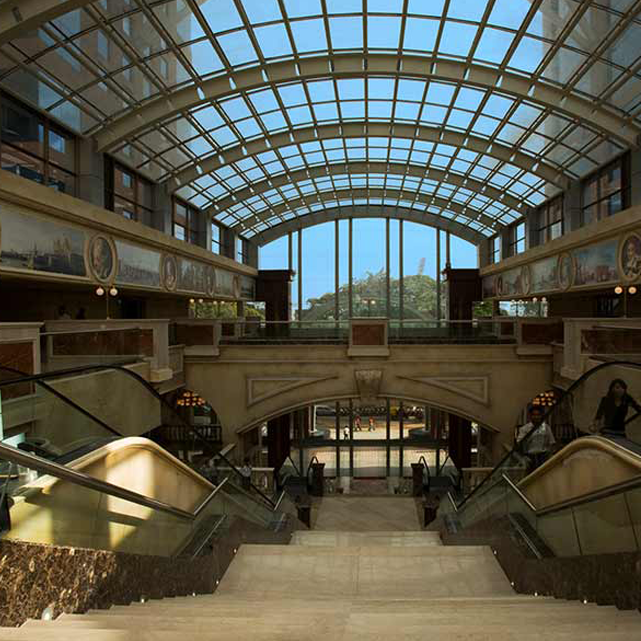
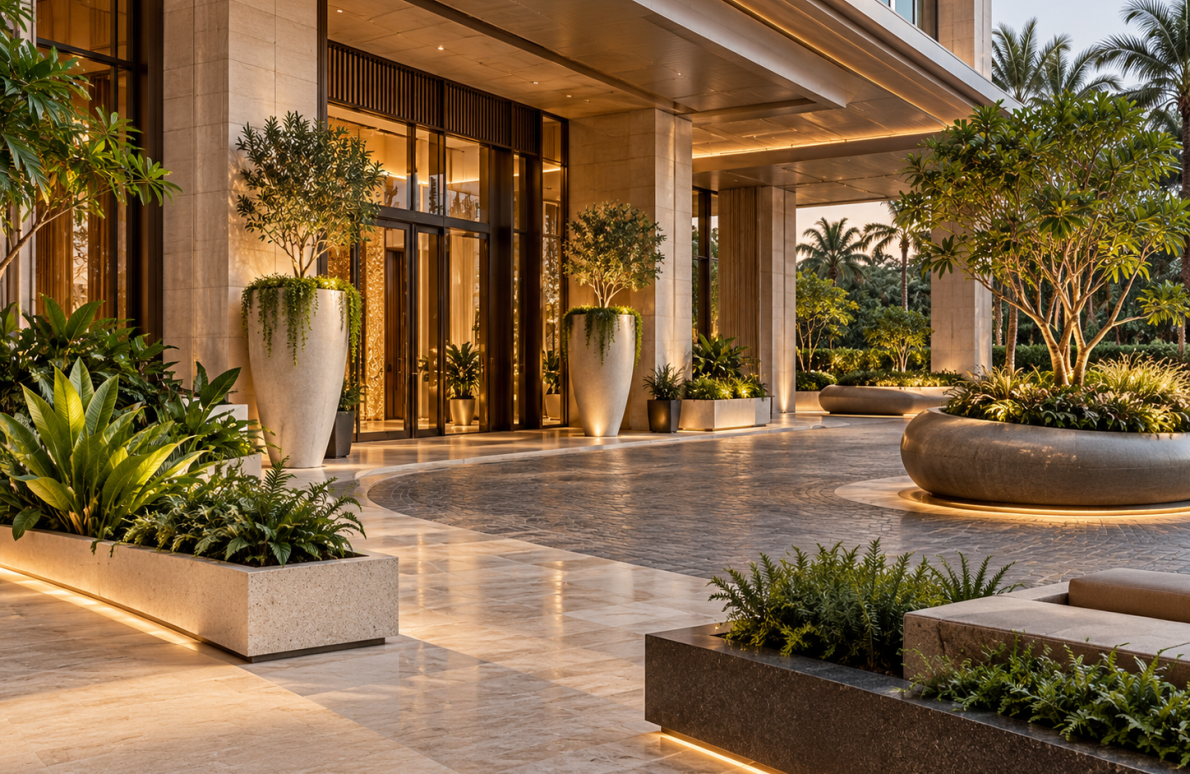
A luxury hotel experience begins long before a guest enters the lobby.
The entrance driveway, drop-off area, landscaped forecourt and architectural details all contribute to the first impression of the property. Every element must communicate quality, comfort and attention to design.
Among these elements, planters play a surprisingly important role.
They frame entrances, guide movement, introduce greenery and create a natural transition between the building and its surroundings. In premium hospitality projects, planters are no longer treated as simple containers for plants. They are designed as architectural landscape elements.
UHPC planters for luxury hotel entrances offer a combination of sculptural design, refined finishes and material durability that makes them suitable for contemporary hospitality architecture.
DECO by The Global Elephant offers architectural UHPC planter solutions that allow designers to explore slender forms, custom geometries and premium surface finishes for project-specific landscapes.
UHPC Planters for Hotel Entrances - At a Glance
Sculptural Forms | Premium Finishes | Weather Resistance | Architectural Integration
Why Hotel Entrance Landscaping Matters
The entrance is one of the most important parts of a luxury hotel.
It creates the first physical interaction between the guest and the property. A well-designed arrival space should feel welcoming, organized and visually connected to the architecture.
Landscape elements play an important role in achieving this experience.
Planters can soften large building surfaces, frame entrance pathways and introduce greenery into areas dominated by paving, glass, stone and concrete.
For luxury hospitality developments, their placement also helps create visual balance.
A pair of statement planters can highlight the main entrance. Long linear planters can define a pedestrian approach. Sculptural forms can create focal points within a large arrival court.
The objective is not simply to add greenery, but to make the landscape feel like an intentional part of the hotel's architecture.
What Makes UHPC Suitable for Architectural Planters?
UHPC stands for Ultra High Performance Concrete, a high-strength cementitious material engineered for durability and refined architectural applications.
Its dense composition and mechanical performance allow appropriately designed planter walls to use relatively slender sections compared with conventional concrete.
This creates opportunities for elegant forms without relying on bulky profiles.
For luxury hotel landscapes, UHPC offers several advantages.
Design Precision: UHPC supports clean edges, controlled geometry and detailed architectural surfaces.
Slender Profiles: Its high strength can allow thinner planter walls, subject to appropriate engineering and reinforcement design.
Durability: UHPC's low permeability and dense structure make it suitable for demanding exterior environments.
Custom Shapes: Planters can be developed with geometric, curved or organic forms to match the project's architectural concept.
Refined Finishes: Smooth, textured and stone-inspired surfaces can complement premium hospitality environments.
These characteristics make UHPC relevant where both material performance and architectural expression matter.
Sculptural UHPC Planter Shapes for Luxury Hotels
The shape of a planter affects how it interacts with the surrounding architecture.
For luxury hotel entrances, selecting the right geometry can make the difference between a conventional landscaped area and a distinctive arrival experience.
Tall Statement Planters
Tall UHPC planters can be positioned near entrance doors, lobby glazing or covered drop-off areas.
Their vertical proportions help frame the entrance and establish a sense of arrival.
They work particularly well when used in symmetrical pairs or carefully planned groups.
Large Rectangular Planters
Rectangular planters are useful for defining pathways, creating green edges and separating pedestrian movement from adjacent spaces.
Their clean lines complement contemporary hotel architecture and can create a coordinated landscape layout.
Curved and Organic Planters
Curved UHPC planters introduce softer forms into spaces dominated by straight architectural lines.
They are particularly suitable for resort-style hotels, landscaped courtyards and hospitality projects that emphasize a connection with nature.
Low-Profile Architectural Planters
Low planters can define landscape zones without obstructing views toward the entrance or surrounding architecture.
They are useful around seating areas, entrance forecourts and garden edges.
Integrating UHPC Planters into the Hotel Arrival Experience
The most effective planter arrangements are developed alongside the overall landscape design.
Instead of placing individual planters after construction, architects can use them to shape the guest's movement through the property.
Entrance Drop-Off Areas
The drop-off zone must accommodate vehicles, luggage handling and pedestrian circulation.
UHPC planters can introduce greenery around this functional space without interfering with movement.
Large planters may be positioned along the edges of the forecourt, creating a softer transition between vehicular areas and the lobby entrance.
Grand Entrance Walkways
Planters can establish visual rhythm along walkways leading toward the hotel entrance.
Repeated forms, consistent finishes and coordinated planting help create a refined approach.
Outdoor Lobby Extensions
Some luxury hotels include open lounges, landscaped waiting areas or seating spaces close to the entrance.
Architectural planters can define these areas while maintaining visual openness.
Entrance Courtyards
For hotels with internal courtyards, UHPC planters can be used as sculptural landscape features.
When combined with lighting, paving and seating, they help create visually memorable spaces.
Choosing the Right Finish for UHPC Planters
Material finishes strongly influence the visual character of a hotel entrance.
A carefully selected finish can make a planter feel contemporary, natural, understated or sculptural.
DECO's architectural finish palette includes several textures that can guide project-specific planter design.
Granite-Inspired Finish: Suitable for formal entrance landscapes requiring a solid, refined appearance.
Sandstone-Inspired Finish: Creates a warmer visual character, especially for resorts and hospitality properties with earthy material palettes.
Pigmented Finish: Allows colour coordination with façades, paving and other exterior elements.
Pitted Texture: Introduces tactile surface depth for sculptural landscape features.
Terracotta-Inspired Finish: Complements natural planting and warmer architectural environments.
Terrazzo-Inspired Finish: Adds a distinctive contemporary material expression.
Final finish availability and suitability should be confirmed for the selected UHPC planter design.
| Hotel Landscape Area | Recommended Planter Design Approach |
|---|---|
| Main Entrance | Tall statement planters to frame the arrival |
| Drop-Off Forecourt | Large geometric planters positioned outside movement paths |
| Entrance Walkways | Linear planters with coordinated planting |
| Outdoor Lobby | Sculptural planters supporting landscape identity |
| Landscaped Courtyards | Curved and organic forms integrated with seating |
| Poolside and Terrace Areas | Weather-resistant planters coordinated with the landscape layout |
Important Specification Considerations
Selecting UHPC planters involves more than choosing an attractive shape.
For luxury hotel projects, architects and landscape designers should consider the technical requirements of each installation.
Planter Dimensions: The size should accommodate the selected plants, root development and intended landscape composition.
Structural Loading: The combined weight of the planter, soil, plants and retained water must be evaluated, particularly on podiums and elevated slabs.
Drainage: Proper drainage is essential to prevent waterlogging and protect surrounding paving and waterproofing systems.
Plant Selection: The planting palette should suit the local climate, available sunlight and maintenance requirements.
Stability: Tall planters should be evaluated for wind exposure, overturning and accidental impact.
Maintenance: Access for watering, cleaning, drainage inspection and plant replacement should be considered during planning.
Thoughtful coordination between the architect, landscape consultant and manufacturer helps ensure the finished installation remains practical and visually consistent.
Frequently Asked Questions
Q1. Why are UHPC planters suitable for luxury hotel entrances?
UHPC planters offer design flexibility, refined finishes and high material durability. They can be developed in slender, contemporary or sculptural forms that complement premium hotel architecture.
Q2. Can UHPC planters be customized for hotel landscape designs?
Yes. UHPC planters can be developed in project-specific shapes, sizes and surface finishes.
Customization allows the planter design to coordinate with the hotel's entrance geometry, architectural palette and landscape concept.
Q3. Are UHPC planters suitable for outdoor exposure in India?
Properly designed and manufactured UHPC planters are suitable for demanding outdoor conditions, including sunlight, rainfall and humidity.
Performance also depends on detailing, finish selection, drainage and maintenance.
Q4. What planter shapes work best for luxury hotel entrances?
Tall planters are useful for framing entrances, rectangular planters work well along walkways, and curved or sculptural forms are suitable for courtyard features.
The selection should reflect the scale and circulation requirements of the space.
Q5. What should architects consider before specifying UHPC planters?
Important factors include planter dimensions, structural loading, drainage, planting requirements, finish selection, stability and maintenance access.
These details should be coordinated during the landscape design stage.
Designing Hotel Entrances with Architectural Purpose
A luxury hotel entrance is more than an arrival point. It establishes the character of the property and introduces guests to the architectural experience that follows.
UHPC planters can contribute to this experience through carefully considered form, proportion, material finish and planting.
They can frame entrances, organize landscaped forecourts and create visual continuity between outdoor spaces and the building façade.
For architects and hospitality developers, UHPC planters offer an opportunity to treat greenery as part of the architectural composition rather than a finishing accessory.
Considering DECO UHPC Planters during the early landscape planning stage can help align planter geometry, finish selection, drainage and planting design into a cohesive and refined hotel entrance environment.