India is building at a pace few countries can match - metro corridors stretching across cities, expressway networks connecting entire regions, and commercial towers rising in every major business district. That scale of construction puts real pressure on material choices, because the materials specified today have to perform for decades under conditions ordinary concrete was never really designed for: relentless urban pollution, extreme monsoon-to-summer temperature swings, heavy structural loads, and maintenance budgets that rarely keep pace with the scale of what's been built. This is where UHPC panels have moved from a niche specification to a genuine infrastructure material.
Why India's Growth Story Needs a Different Kind of Concrete
Most conversations about UHPC (Ultra-High-Performance Concrete) focus on its use in premium architecture - sculptural facades, boutique hotels, landmark buildings. That's a valid application, but it undersells where the material is actually having its biggest impact: large-scale infrastructure and commercial development, where performance, speed, and lifecycle cost matter more than aesthetics alone.
Metro stations, flyovers, commercial towers, and transit infrastructure share a common set of demands. They need to be built fast, since public infrastructure projects operate under tight completion timelines and heavy public scrutiny. They need to perform structurally under continuous load and vibration. And they need to survive with minimal maintenance, because retrofitting or repairing infrastructure at scale - closing a metro station or scaffolding a commercial tower for facade repair - is disruptive and expensive in ways that dwarf the original material cost.
What UHPC Actually Brings to Large-Scale Projects
Strength that reduces material volume. UHPC achieves compressive strengths several times higher than conventional concrete, along with significantly improved tensile and flexural performance through its dense fibre-reinforced matrix. In practical terms, that means structural and cladding elements can be engineered thinner and lighter while still meeting or exceeding the load requirements of much bulkier conventional concrete sections - a genuine advantage on projects where every tonne of dead load affects foundation design and construction cost.
Faster construction cycles. For infrastructure projects working against public deadlines, UHPC's high early strength allows for faster formwork removal and quicker installation sequencing. Precast uhpc panels manufactured off-site can be transported and installed with far less on-site curing time than cast-in-place conventional concrete, which shortens project timelines without compromising structural performance.
Durability under continuous stress and exposure. Metro viaducts, flyovers, and commercial building envelopes are exposed to constant vibration, temperature cycling, and - in most Indian cities - significant airborne pollution and particulate exposure. UHPC's extremely low permeability limits the ingress of moisture, chlorides, and pollutants that typically drive long-term degradation in conventional concrete, which translates directly into a longer service life with less intervention.
Lower lifecycle cost despite higher upfront cost. UHPC costs more per cubic metre than standard concrete, and any honest assessment of the material has to say so upfront. But for large infrastructure and commercial assets evaluated over a 30–50 year lifecycle, the reduction in maintenance frequency, repair disruption, and material degradation typically shifts the total cost of ownership in UHPC's favour - a calculation that matters far more to infrastructure agencies and institutional developers than the initial line-item cost.
Where UHPC Facade Panels Are Making the Biggest Difference
Metro and transit infrastructure. Station facades, platform screens, and structural cladding elements benefit from UHPC's combination of strength, low weight, and resistance to the constant wear of high-footfall public infrastructure. Several Indian metro projects have already begun specifying high-performance concrete systems for exactly these reasons - durability under heavy public use with minimal ongoing maintenance.
Flyovers, bridges, and expressway structures. UHPC's fatigue resistance and reduced permeability make it well suited to structural elements exposed to continuous vibration and load cycling, where conventional concrete is more prone to long-term cracking and reinforcement corrosion.
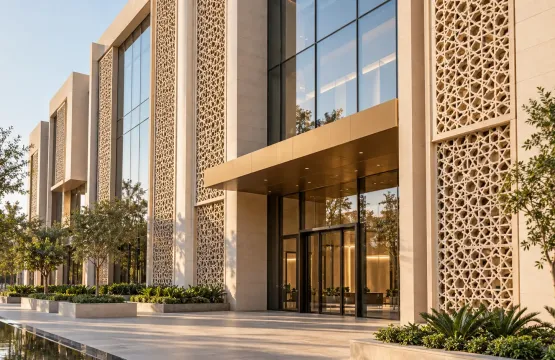
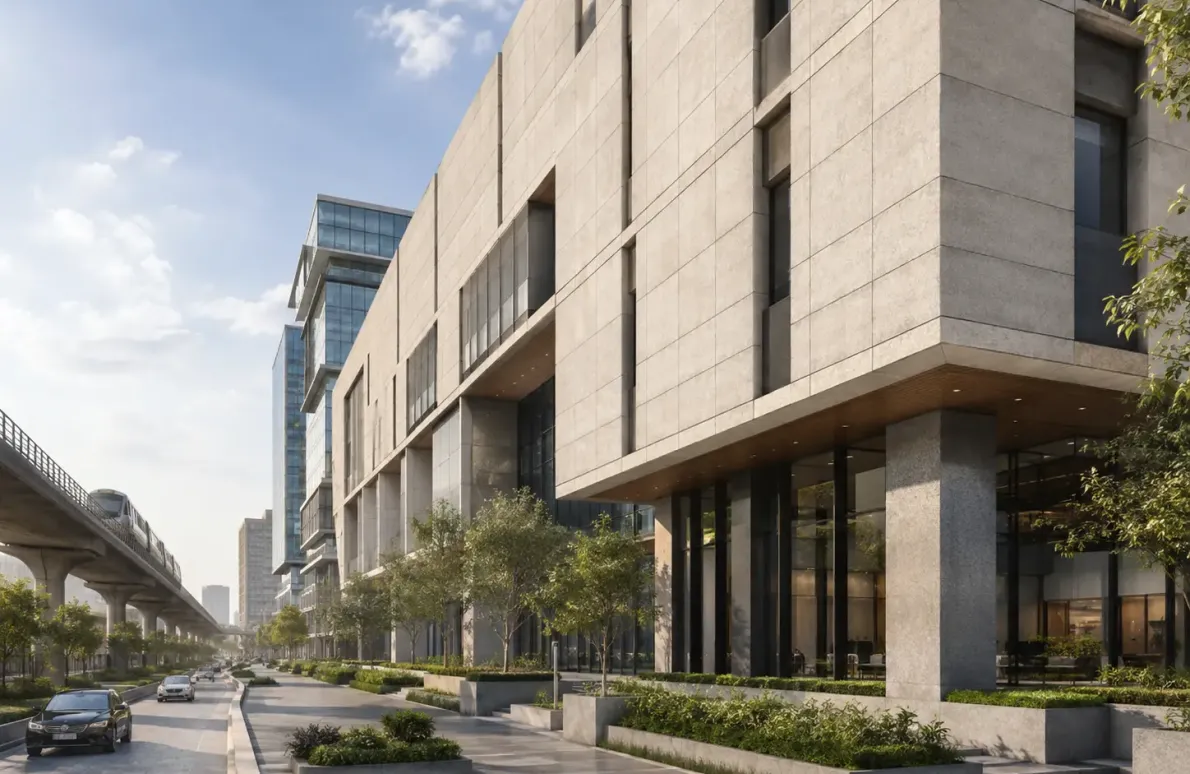
Commercial towers and business districts. For high-rise commercial buildings, UHPC facade panels offer architects a way to achieve slender, contemporary envelope designs while reducing overall facade weight - a meaningful advantage for tall structures where cumulative facade load affects structural design and foundation sizing.
Institutional and government infrastructure. Airports, government complexes, and public institutional buildings increasingly specify UHPC for the same combination of durability and reduced maintenance burden that makes it attractive for transit infrastructure - public assets need to look presentable and structurally sound for decades with limited maintenance intervention.
Industrial and logistics infrastructure. Warehousing, logistics parks, and industrial facilities benefit from UHPC's strength-to-weight ratio in structural elements exposed to heavy operational loads and, in many cases, aggressive environmental conditions.
What Makes UHPC Different at the Material Level
The performance gains come down to composition. UHPC uses an extremely low water-to-cement ratio combined with fine reactive powders - silica fume, ground quartz, and similar materials - that pack together far more densely than conventional concrete's aggregate structure. This dense packing dramatically reduces capillary porosity, which is the primary pathway through which water, chlorides, and other degrading agents penetrate concrete over time.
Fibre reinforcement, typically steel or synthetic fibres dispersed through the mix, gives UHPC tensile and flexural capacity that conventional concrete - reliant almost entirely on embedded rebar for tensile strength - simply doesn't have. This combination is what allows UHPC to be cast into thin, structurally capable panels and elements that would require far bulkier, heavier sections in standard concrete.
Specification Considerations for Infrastructure and Commercial Projects
A few factors matter more at this scale than they might on a smaller architectural project:
- Structural engineering integration from the design stage. UHPC's performance advantages are only realised when structural engineers design specifically around its properties, rather than treating it as a drop-in replacement for conventional concrete sections.
- Precast manufacturing quality control. For infrastructure-scale projects requiring hundreds or thousands of panels, consistent quality across production batches depends on a manufacturer with genuine factory process control, not ad-hoc casting.
- Transport and installation logistics. Even though uhpc panels are lighter than conventional concrete equivalents, large-scale infrastructure projects need installation sequencing planned around panel size, crane access, and site constraints from the outset.
- Long-term maintenance and inspection planning. While UHPC significantly reduces maintenance frequency, infrastructure asset owners should still plan periodic inspection protocols appropriate to the specific application and exposure conditions.
The Bottom Line
India's infrastructure and commercial construction pipeline is too large, too fast-moving, and too publicly visible to keep relying exclusively on materials that demand constant maintenance intervention. UHPC panels offer a genuine engineering answer to that pressure - higher strength at lower weight, faster construction cycles, and a durability profile that holds up to decades of continuous public and commercial use.
DECO, from The Global Elephant, manufactures uhpc facade panels engineered for exactly this scale of application - from metro and transit infrastructure to commercial towers and institutional developments across India.
To explore DECO's UHPC panel range and technical capabilities, visit DECO Panels by The Global Elephant.