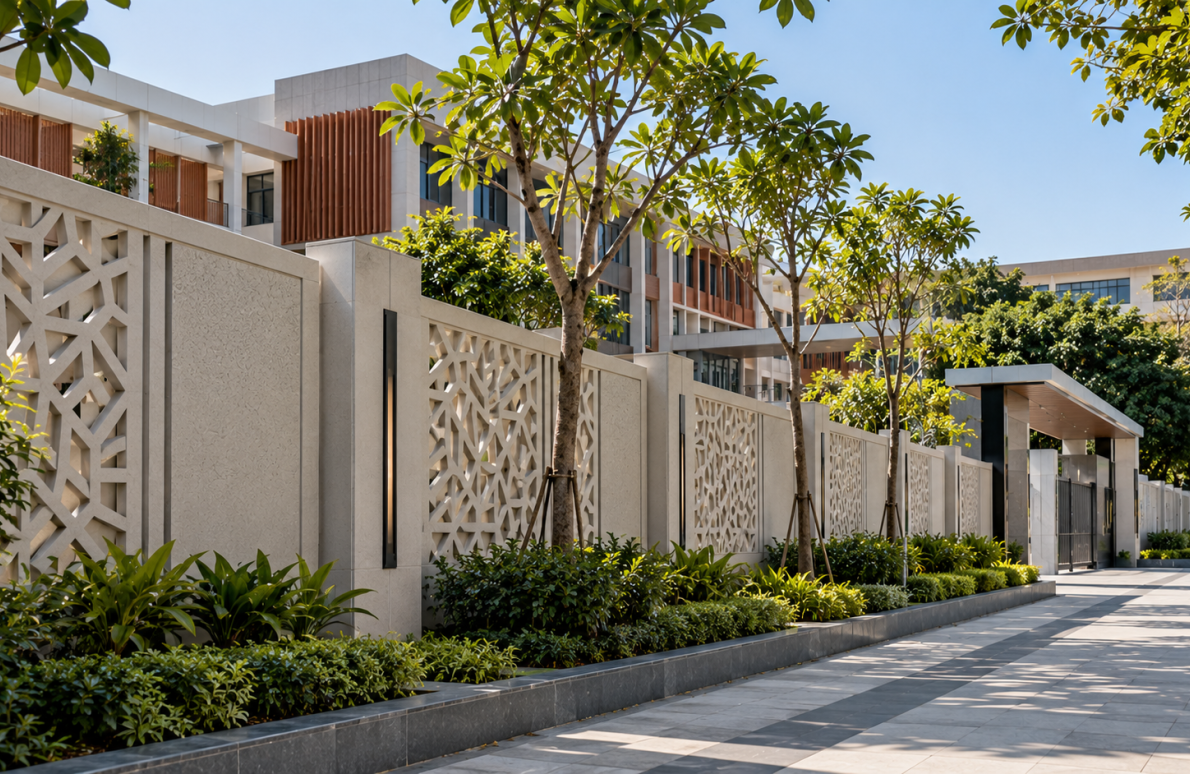
The boundary of an educational campus serves a greater purpose than simply marking the edge of a property.
For schools, colleges, universities and institutional developments, fencing must provide security, organize access and establish a clear separation between campus activities and surrounding public areas.
At the same time, the boundary contributes to the institution's architectural identity. A thoughtfully designed fence can create a consistent visual character across entrances, landscaped edges and large property perimeters.
This is where modular GRC fencing offers a practical architectural solution.
Combining durable concrete-based construction with customizable designs, GRC fence systems can provide defined campus boundaries while complementing contemporary institutional architecture.
DECO GRC Fences by The Global Elephant are developed as modular architectural boundary systems, offering controlled detailing, consistent finishes and project-specific design flexibility.
Modular GRC Fencing - At a Glance
Modular Construction | Defined Boundaries | Architectural Consistency | Exterior Durability
Why Educational Campuses Need Thoughtful Boundary Design
Educational campuses often occupy large sites with multiple functional zones.
Classroom buildings, administration blocks, playgrounds, sports facilities, laboratories, parking areas and landscaped spaces may all exist within the same development.
The boundary system must respond to these different uses while maintaining a consistent architectural appearance.
For schools, fencing is particularly important because student safety, controlled access and visibility require careful planning.
For universities and institutional campuses, boundaries may extend across large areas and include several entrances, internal roads and service access points.
A modular fencing system can help create visual continuity while allowing the overall boundary layout to respond to changing site conditions.
What Is Modular GRC Fencing?
GRC stands for Glass Reinforced Concrete, a cement-based composite reinforced with glass fibres.
Modular GRC fencing uses prefabricated architectural fence elements arranged in repeatable sections to create a continuous boundary.
Unlike conventional masonry walls, modular systems are developed through coordinated panel dimensions, support arrangements and installation details.
DECO GRC Fences are based on modular, interlocking design principles intended to support alignment and structural continuity.
The system can be developed with customized surface patterns, textures and finishes suited to the project's architectural requirements.
For educational campuses, this approach can help maintain consistent boundary detailing across extensive site perimeters.
Creating Secure and Defined Campus Boundaries
Security is one of the most important considerations in institutional fencing.
Educational campuses require clear boundaries that help manage access and separate internal activities from surrounding roads and public areas.
GRC fencing can provide solid or partially screened architectural boundaries depending on the design.
However, a secure campus perimeter requires more than the choice of material.
Fence height, opening dimensions, anti-climb detailing, impact resistance, fixing systems and controlled entry points must all be considered.
For schools, these requirements should be coordinated with student safety policies and applicable building regulations.
A properly planned modular fence system can support the overall perimeter strategy while maintaining an organized architectural appearance.
Architectural Identity Across Large Campuses
Educational institutions often develop a recognizable visual identity through their buildings, entrances, landscape and material palette.
Boundary fencing can support this identity.
Repeated GRC modules create visual rhythm along campus edges, while customized finishes can complement classroom façades and administrative buildings.
For example, a contemporary university may prefer clean geometric fencing profiles with neutral finishes.
An institutional campus with a traditional architectural character may use textured panels inspired by stone or other regional materials.
The objective is to create a boundary that feels connected to the overall development rather than appearing as an unrelated security installation.
Modular Fencing for Large Institutional Sites
Large educational campuses often require fencing across extensive and irregular site boundaries.
A modular system offers advantages in planning and execution.
Repeated panel dimensions can simplify production coordination, while a consistent module arrangement helps maintain alignment along straight boundary sections.
At corners, changes in level, entrance locations and irregular property edges, the modular layout must be adapted to site conditions.
This makes early planning particularly important.
Panel sizes, support spacing, foundation requirements and movement joints should be coordinated before installation.
For institutions undergoing phased development, modular planning can also help establish a consistent boundary language as new campus zones are constructed.
Integrating GRC Fences with Campus Landscapes
The boundary of a campus is often visible from pedestrian pathways, gardens and outdoor recreational areas.
Its relationship with the landscape therefore matters.
GRC fencing can be coordinated with planting beds, entrance features, paved walkways and outdoor gathering areas.
Solid fencing may be appropriate where visual separation is required, while partially open designs can be considered where supervision and sightlines are important.
The selected approach should reflect the function of each campus zone.
A thoughtfully integrated boundary helps maintain the open character of landscaped areas while defining the campus perimeter.
Why GRC Works for Institutional Fencing
GRC offers several characteristics that make it suitable for architectural boundary applications.
Design Flexibility: GRC can be moulded into customized panels, geometric profiles and textured surfaces.
Modular Construction: Repeated elements can help maintain consistent patterns and finishes across large campus boundaries.
Weight Efficiency: GRC elements can be lighter than comparable conventional solid concrete components, depending on the panel design.
Exterior Durability: Properly manufactured and installed GRC can perform in outdoor conditions involving sunlight, rainfall and temperature variations.
Finish Options: GRC fencing can be coordinated with the architectural palette of educational buildings and surrounding landscapes.
These characteristics make modular GRC fencing relevant for institutional projects where both boundary performance and visual consistency are important.
Finishes for DECO GRC Fences
The surface finish influences how the boundary relates to the campus architecture.
DECO's architectural finish range includes:
- Granite Finish
- Sandstone Finish
- Pigmented Finish
- Pitted Finish
- Terracotta Finish
- Terrazzo Finish
For contemporary educational campuses, neutral concrete or stone-inspired finishes may create a clean and consistent appearance.
Warmer finishes can complement landscaped environments and traditional institutional buildings.
The final finish should be selected with attention to site exposure, architectural compatibility and maintenance requirements.
Where Modular GRC Fencing Can Be Used
| Campus Application | Design Approach |
|---|---|
| School Perimeters | Secure fencing with appropriate height and anti-climb detailing |
| University Campuses | Repeated modular fence systems for extensive boundaries |
| College Entrances | Architectural fencing coordinated with gates and entrance features |
| Institutional Landscapes | Textured GRC fence panels complementing campus greenery |
| Sports and Recreation Zones | Defined boundaries planned around activity and impact requirements |
| Service and Utility Areas | Screening elements that integrate functional zones into the campus design |
Important Specification Considerations
Modular GRC fencing should be developed according to site conditions and the institution's operational requirements.
Structural Stability: Panels, posts and foundations must be designed for applicable wind, impact and other relevant loads.
Panel Dimensions: Module size should account for transportation, handling, installation and support spacing.
Site Levels: Changes in ground elevation should be addressed through suitable foundation and panel arrangements.
Student Safety: Schools should avoid hazardous projections, unsafe openings and easily climbable details in accessible locations.
Entrance Coordination: Fence design should integrate with gates, security checkpoints and emergency access routes.
Drainage: Foundation and boundary detailing should allow proper surface-water movement and avoid obstructing drainage paths.
Maintenance: Inspection access, surface cleaning and replacement of individual components should be considered during specification.
These considerations help ensure that the fencing system remains practical for long-term institutional use.
Frequently Asked Questions
Q1. Is modular GRC fencing suitable for school campuses?
Yes. Modular GRC fencing can be considered for school boundaries when designed according to applicable structural and safety requirements.
Fence height, opening dimensions, anti-climb features and access control must be evaluated for the specific campus.
Q2. What are the benefits of modular GRC fencing for universities?
Modular GRC fencing can provide consistent architectural detailing across large property boundaries.
Its repeatable panel arrangement may also simplify production planning and phased installation.
Q3. Can DECO GRC Fences be customized?
DECO offers architectural GRC fencing with options for project-specific designs, panel configurations and finishes.
Customization can help the boundary complement the institution's buildings and landscape.
Q4. Are GRC fence panels suitable for Indian weather conditions?
Properly designed and manufactured GRC panels are suitable for exterior applications.
Performance depends on material quality, panel detailing, structural support, site exposure and regular inspection.
Q5. What should architects consider before selecting GRC fencing?
Important considerations include security requirements, structural loading, panel dimensions, foundation conditions, site levels, entrance integration, finish selection and maintenance access.
For educational buildings, student safety and emergency accessibility are particularly important.
Designing Campus Boundaries with Architectural Purpose
An educational campus boundary should provide more than physical separation.
It should support security, guide access, complement the surrounding architecture and maintain visual consistency across the property.
Modular GRC fencing offers a way to combine repeatable construction with project-specific architectural detailing.
Its adaptable panel configurations, finish possibilities and durable material characteristics make it relevant for schools, universities and institutional developments in India.
For architects and campus planners, considering DECO GRC Fences during the early master-planning stage can help coordinate boundary design, landscape integration, security requirements and installation planning into a cohesive architectural solution.