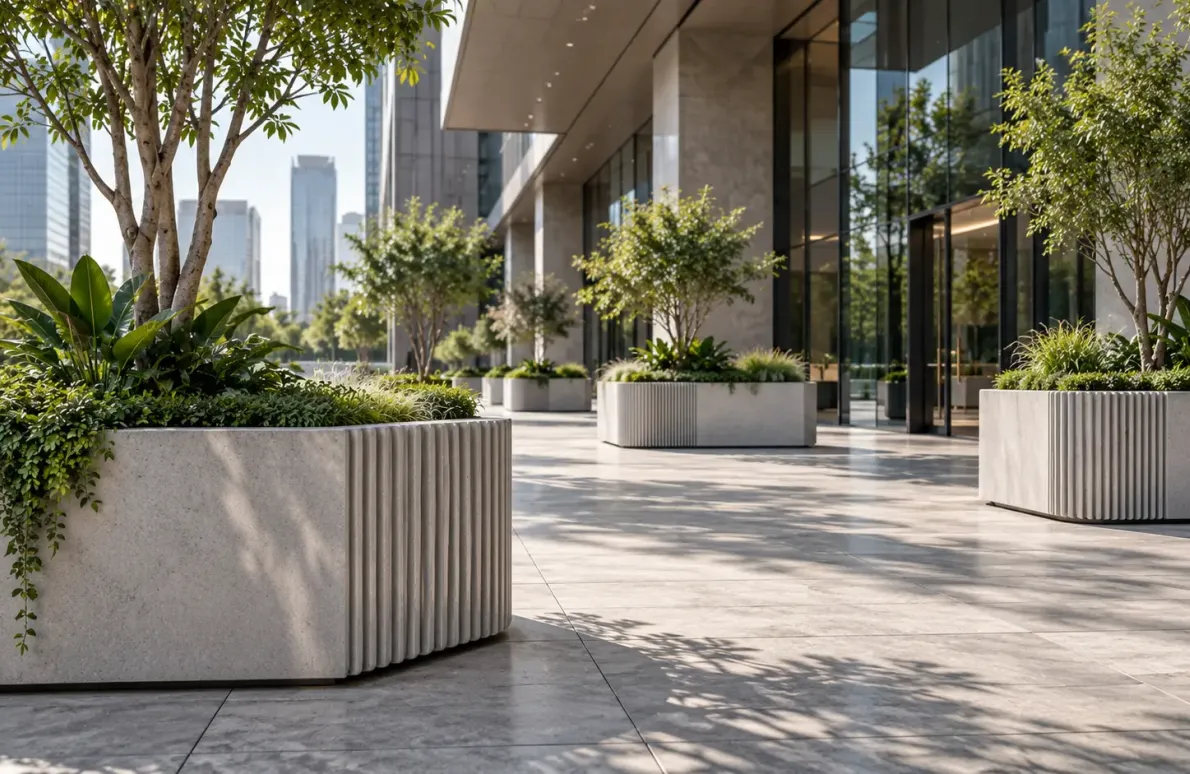
When you're designing the landscape around a commercial building - a corporate campus, retail plaza, hotel entrance, or mixed-use development - the planters you choose do more than hold greenery. They frame the entrance, define pedestrian zones, soften hard architecture, and communicate the quality of the entire development. That's why more architects, landscape designers, and property developers are turning to GRC outdoor planters as their material of choice for large-scale commercial installations.
Glass Reinforced Concrete (GRC) has quickly become the go-to solution for projects that demand large planters without the drawbacks of solid concrete - namely, excessive weight, slow lead times, and design limitations. This guide walks through everything architects and developers need to know before specifying GRC planters for a commercial project, from material properties to sizing, cost, and long-term maintenance.
What Is GRC and Why Does It Matter for Outdoor Planters?
GRC is a composite material made from cement, sand, water, and alkali-resistant glass fibers. The glass fibers reinforce the cement matrix, giving the finished product much higher tensile strength than standard concrete - while using significantly less material and weight.
For outdoor planters, this translates into a few practical advantages:
- Thinner walls, lighter structures - a GRC planter can be up to 70% lighter than an equivalent solid concrete planter.
- Greater design flexibility - GRC can be cast into complex geometric shapes, sharp edges, curves, and custom sizes that would be impractical or cost-prohibitive in poured concrete.
- High strength-to-weight ratio - despite being lightweight, GRC resists cracking, impact, and weathering far better than fiberglass or lightweight concrete alternatives.
This combination of strength, weight savings, and design freedom is precisely why GRC outdoor planters have become a preferred specification for large commercial developments where both aesthetics and engineering constraints matter.
Why Commercial Projects Are Choosing GRC Planters Over Alternatives
Architects typically compare GRC against three other common planter materials: solid concrete, fiberglass, and corten steel. Here's how GRC stacks up for large-scale commercial use.
1. Weight and Structural Load Considerations
Rooftop gardens, podium decks, plazas over parking structures, and elevated terraces all have strict load limits. Solid concrete planters, especially in large sizes, can push a project over its structural allowance. GRC planters solve this by delivering the visual mass of concrete at a fraction of the dead load - a critical factor when planters are specified for roof terraces or structural slabs.
2. Durability in Outdoor and High-Traffic Environments
Unlike fiberglass, which can become brittle, fade, or crack under UV exposure and temperature swings, GRC is inherently weather-resistant. It withstands freeze-thaw cycles, coastal salt exposure, and heavy foot traffic areas without warping or discoloring prematurely - making it ideal for retail centers, airports, hotels, and office campuses that need planters to look sharp for a decade or more.
3. Design Consistency at Scale
Large commercial developments often require dozens or even hundreds of identical planters across a site. GRC's mold-based manufacturing process ensures dimensional consistency across large orders, which is essential when planters need to align precisely with architectural plans, hardscape modules, or facade rhythms.
4. Fire Rating and Safety Compliance
Because GRC is a cementitious, non-combustible material, it typically meets fire safety codes more easily than fiberglass or resin-based planters - an important consideration for buildings near entrances, egress paths, or areas with fire code scrutiny.
Key Factors to Evaluate Before Specifying Large GRC Planters
If you're preparing specifications or issuing an RFQ for GRC outdoor planters, here are the technical and practical factors to nail down early.
Size and Scale
Large-format planters (48 inches and above) are where GRC truly outperforms alternatives. Confirm:
- Maximum single-piece dimensions the manufacturer can cast without joints
- Whether oversized units ship in sections for on-site assembly
- Weight per unit (empty and filled with soil) for crane, forklift, or manual handling logistics
Wall Thickness and Reinforcement
Ask manufacturers about wall thickness specifications and internal reinforcement detailing, especially for planters that will be filled with heavy soil volumes or planted with mature trees.
Drainage and Root Management
Confirm drainage hole placement, root barrier options, and whether the manufacturer offers integrated irrigation reservoirs - especially important for planters supporting trees or dense plantings in exposed rooftop conditions.
Finish and Color Options
GRC accepts a wide range of surface finishes: smooth polished concrete looks, textured or fluted profiles, exposed aggregate, and integral color pigmentation. For commercial branding-conscious clients, custom color matching (to Pantone or RAL codes) is often available.
Frost Resistance and Climate Suitability
If the project is in a freeze-thaw climate, verify the manufacturer's GRC mix design includes adequate freeze-thaw testing and that drainage design prevents water pooling and ice expansion cracking.
Anchoring and Wind Load
For rooftop or elevated installations, large planters may need ballast or mechanical anchoring to resist wind uplift - a detail that should be coordinated with the structural engineer early in design development.
Lead Time and Custom Fabrication
Custom GRC planters typically require mold fabrication, which adds lead time compared to stock sizes. For large commercial orders, build in 6–12 weeks (or more, depending on scale and complexity) between order confirmation and delivery.
Common Applications for GRC Planters in Commercial Projects
- Office building entrances and plazas - large planters used to define arrival sequences and soften hardscape
- Retail and mixed-use developments - planters as pedestrian buffers between traffic and storefronts
- Hotels and hospitality - decorative, branded planters at porte-cochères and outdoor lounges
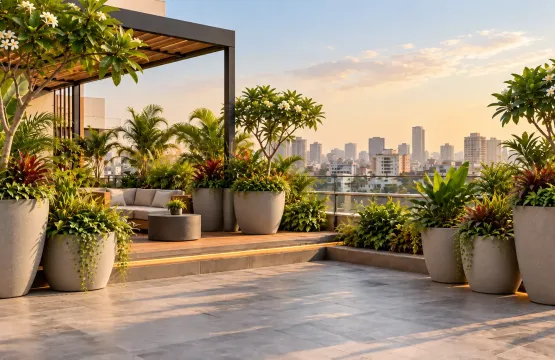
- Rooftop terraces and podium decks - lightweight planters where structural load is restricted
- Corporate campuses - modular planter systems used to create green partitions and outdoor meeting zones
- Streetscape and urban design projects - GRC planters doubling as traffic bollards, seating edges, or planted medians
Cost Considerations for Large-Scale GRC Planter Projects
Pricing for GRC outdoor planters varies based on size, custom mold requirements, finish complexity, and order volume. As a general guide:
- Stock sizes and standard finishes are the most cost-effective option for phased or repeat orders.
- Custom molds carry a one-time tooling cost, which is amortized more efficiently across larger order quantities - making GRC especially cost-competitive for developments needing 20+ identical units.
- Freight and handling should be factored in separately, since large planters may require specialized crating, palletizing, or oversized freight logistics.
When comparing quotes, ask suppliers to break out mold/tooling costs, per-unit production costs, and shipping separately so you can accurately compare bids across vendors.
Questions to Ask a GRC Planter Manufacturer Before Ordering
- Can you provide structural load data (weight, filled weight) for engineering review?
- What is your standard wall thickness, and can it be increased for larger units?
- Do you offer custom sizing, and what is the minimum order quantity for custom molds?
- What finish and color options are available, and can you match a specific Pantone/RAL code?
- What is your typical lead time for a commercial order of this scale?
- Do you provide drainage, irrigation reservoir, or root barrier integration?
- Can you supply test certifications for freeze-thaw resistance and fire rating?
- What warranty do you offer on material integrity and finish?
Final Thoughts: Why GRC Is the Smart Choice for Commercial Landscaping
For architects and developers balancing design intent with structural and budget realities, DECO GRC planters offer a rare combination: the visual weight and permanence of concrete, without the load, lead-time, and design constraints that come with it. Whether you're specifying planters for a rooftop terrace, a retail plaza, or a corporate campus entrance, GRC delivers the durability and design flexibility that large-scale commercial projects demand.
Before finalizing your planter specification, take the time to vet manufacturers on structural data, finish quality, and lead times - the right partner will make the difference between planters that merely look good in a rendering and ones that perform beautifully on-site for decades.
FAQs
What does GRC stand for in planters?
GRC stands for Glass Reinforced Concrete - a composite material combining cement and alkali-resistant glass fibers to create a lightweight, high-strength alternative to solid concrete.
Are GRC planters suitable for rooftop installations?
Yes. Their lightweight construction makes GRC planters one of the most practical choices for rooftops, podium decks, and other structures with load restrictions.
How long do GRC outdoor planters last?
With proper drainage and a quality mix design, GRC planters can last 15–25+ years in outdoor commercial environments, even in harsh climates.
Can GRC planters be customized for branding or specific architectural designs?
Yes. GRC's mold-based manufacturing process allows for custom shapes, sizes, textures, and integral color matching to suit branding or architectural requirements.
Are GRC planters more expensive than concrete or fiberglass planters?
GRC planters are generally more cost-effective than solid concrete at scale (due to lower shipping/handling weight) and more durable long-term than fiberglass, making them a strong value proposition for large commercial orders.