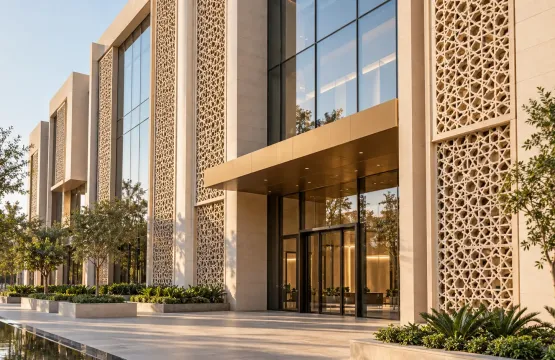
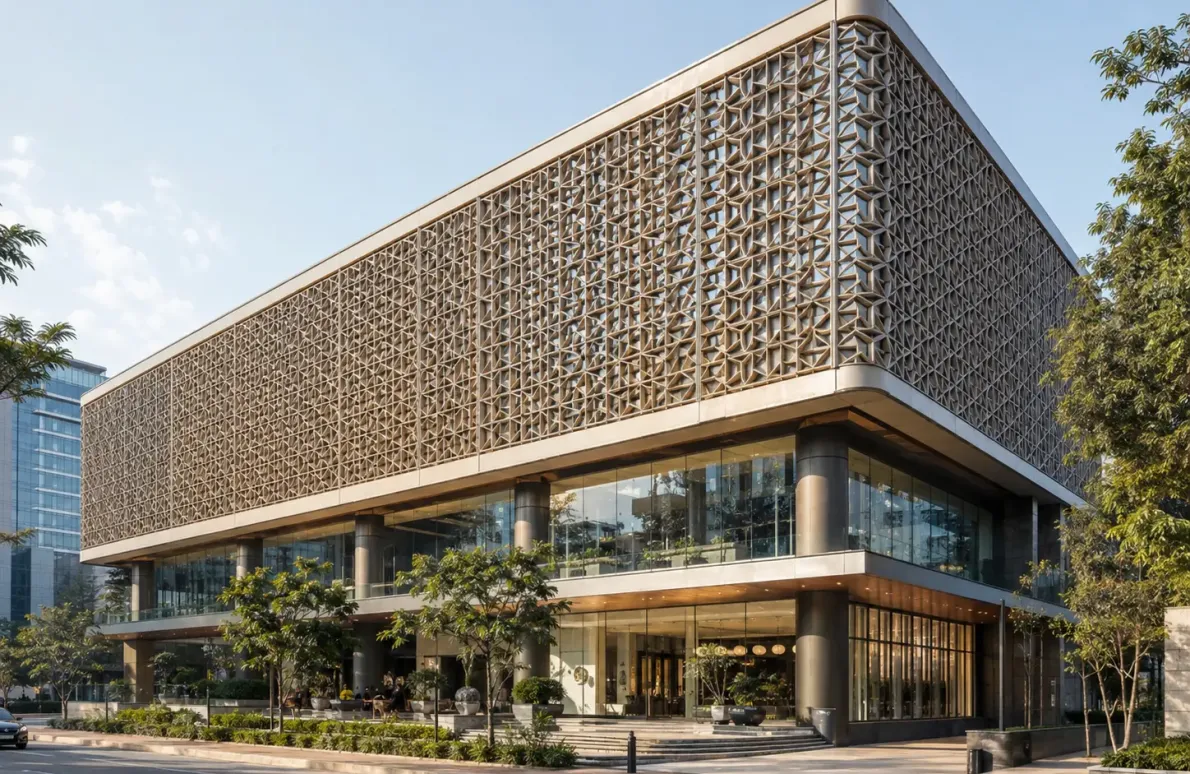
Walk through any major business district today and most commercial towers blur together - glass curtain walls, aluminium composite panels, the same handful of grey and blue palettes repeated block after block. In that landscape, a building that actually looks like something that you can describe to someone else and have them picture it, has a real commercial advantage. Increasingly, exterior GRC Jali is how developers and brands are creating that advantage.
This isn't about decoration. It's about treating the facade as a communication tool - one that carries a brand's identity the way a logo, a colour palette, or a retail interior does, except at the scale of an entire building, visible from the street, day and night, for decades.
Why Commercial Buildings Need a Visual Signature
For retail flagships, hospitality properties, corporate headquarters, and mixed-use developments, the building itself is often the first brand touchpoint a customer or visitor encounters - before a website, before a lobby, before a single interaction with staff. A generic glass box communicates nothing. A facade with a distinctive, recognisable pattern language does the opposite: it signals identity before anyone reads a sign.
This is precisely the design problem exterior GRC Jali solves well. Because GRC can be cast into intricate, repeatable geometric patterns at building scale, it gives architects a way to encode a brand's visual language - a motif, a proportion system, a cultural reference - directly into the building's skin, rather than treating branding as something applied afterward through signage.
What Makes GRC the Right Material for Brand-Driven Facades
Pattern precision at scale. A brand identity lives or dies on consistency. GRC's mould-cast manufacturing process means a signature pattern can be reproduced identically across hundreds of panels covering an entire tower, without the drift in detail that hand-fabricated metal or stone screens tend to develop over a large facade run.
Durability that protects the brand investment. A branded facade that fades, stains, or degrades within a few years actively works against the brand it was meant to project. GRC's weather resistance and low-porosity finish mean the pattern - and the identity it carries - stays crisp for decades, not just for the opening photoshoot.
Depth and shadow play that photographs well. Perforated GRC Jali creates genuine three-dimensional depth, with shifting shadow patterns across the day. For brands that rely heavily on visual media - hospitality, retail, entertainment - a facade that photographs differently at 9am and 6pm gives marketing and PR teams a building that keeps generating fresh content on its own.
Lightweight enough for ambitious geometry. Because exterior GRC Jali panels are a fraction of the weight of precast concrete, architects can push pattern scale, panel size, and cantilevered or curved facade sections that would be structurally impractical in heavier materials - which matters when a brand identity calls for something more sculptural than a flat screen.
Building a Facade Pattern That Actually Says Something
The difference between a Jali facade that reads as generic ornamentation and one that functions as genuine brand identity comes down to where the pattern originates. A few approaches that work consistently well:
- Deriving the pattern from an existing brand mark - abstracting a logo's geometry, proportions, or a recurring motif into a repeatable Jali module, so the facade pattern is unmistakably tied to the brand rather than a generic jali design pulled from a catalogue.
- Referencing cultural or regional design language - for hospitality and mixed-use developments especially, a pattern rooted in local architectural motifs can position a property as authentically connected to its place, rather than a generic international box.
- Varying density to create a wordmark or symbol at distance - some of the most effective branded facades use variation in perforation density across the pattern to form a recognisable silhouette or symbol when viewed from the street, invisible up close but unmistakable from a distance.
- Carrying the pattern language across multiple touchpoints - the strongest examples extend the same Jali motif from the exterior facade into interior screens, signage backdrops, or landscape elements, so the identity feels continuous rather than confined to the building envelope.
Where This Strategy Delivers the Most Value
Retail flagships and mixed-use developments, where the building's exterior is directly competing for attention against neighbouring properties and needs to be recognisable from a distance, not just up close.
Hospitality and entertainment destinations, where the facade is part of the guest experience and marketing asset from the first arrival photo onward, and where a distinctive silhouette contributes directly to word-of-mouth and social visibility.
Corporate headquarters, where a signature facade pattern signals institutional permanence and design ambition to clients, investors, and employees alike - a building people can point to and name.
Large-scale developments with phased construction, where a consistent Jali language applied across multiple buildings over several years creates a unified identity for the entire development, even as individual towers are completed at different times.
What Project Teams Should Get Right at the Brief Stage
Turning a brand identity into a workable facade pattern is a collaborative process between the brand, the architect, and the manufacturer - and it works best when a few things are addressed early rather than left to the detailing phase:
- Involve the manufacturer during concept design, not after the facade is finalised - pattern openness ratios, panel sizing, and structural feasibility all affect how faithfully a brand concept translates into a buildable Jali design.
- Test the pattern at actual viewing distances, since a motif that reads clearly on a rendering can lose legibility - or become overly busy - at the scale and distance the building will actually be seen from.
- Plan for lighting from day one, since exterior GRC Jali facades often perform double duty after dark, with backlighting turning the same pattern into a completely different nighttime brand statement.
- Confirm long-term finish consistency, particularly for developments built in phases, so a pattern installed in year one still matches a panel manufactured for year three.
The Bottom Line
Commercial architecture is increasingly competing in the same attention economy as everything else a brand produces - and a facade that looks like every other glass tower on the street isn't doing its job. Exterior GRC Jali gives developers and architects a way to turn a building's skin into a genuine, lasting piece of brand identity - precise enough to stay on-brand at scale, durable enough to still look sharp a decade later, and distinctive enough to be recognised from a distance.
DECO, from The Global Elephant, works with architects and brand teams to translate identity into buildable GRC Jali facade systems - from concept pattern development through to manufacturing and installation.
To explore DECO's exterior GRC Jali capabilities and pattern possibilities, visit DECO Jalis by The Global Elephant.