A waterfront promenade is more than a pathway beside the water. It is a public space where people walk, pause, observe the surroundings and spend time outdoors.
From coastal walkways and riverfront developments to urban parks and landscaped public plazas, these environments require seating that complements the landscape while responding to frequent use and outdoor exposure.
Conventional benches provide functional seating, but contemporary landscape design increasingly explores furniture that becomes part of the surrounding environment.
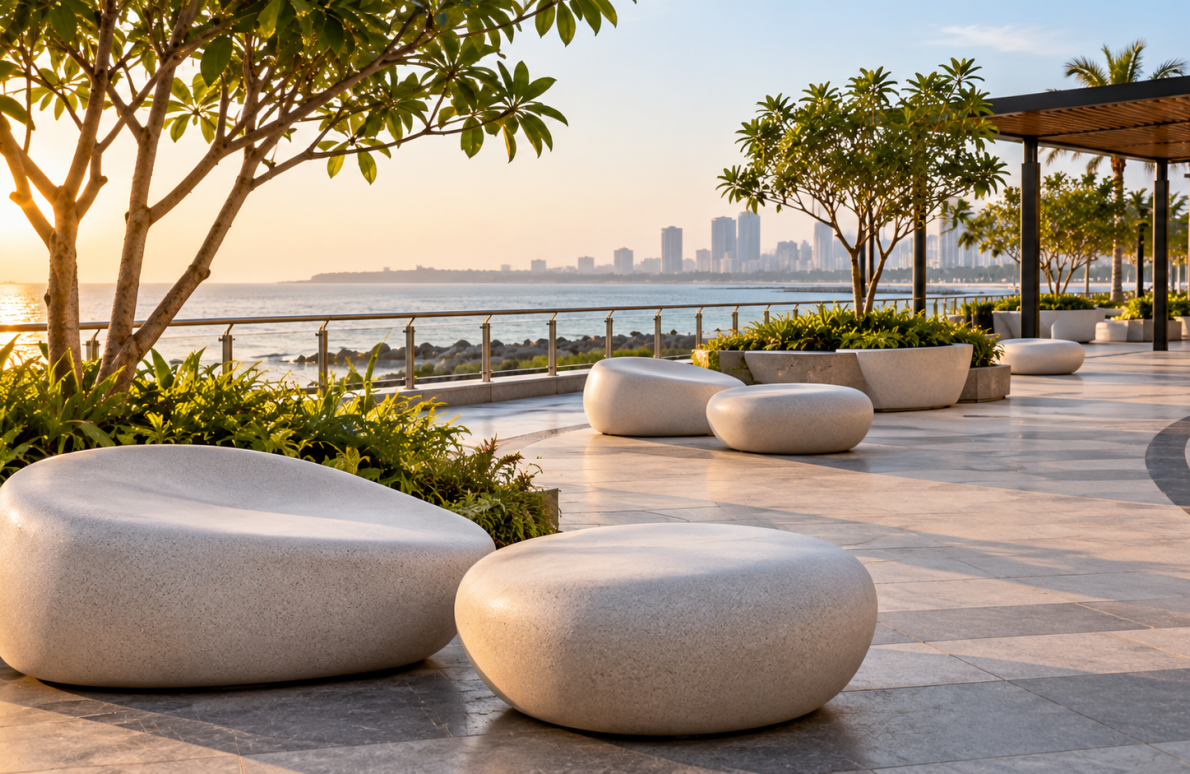
GRC Seating Pebbles offer a sculptural approach to outdoor seating.
Inspired by the smooth forms of natural stones, these architectural elements create informal resting points while adding texture, character and visual continuity to public landscapes.
DECO Architectural Pebbles by The Global Elephant combine organic geometry, durable GRC construction and customizable finishes for contemporary outdoor environments.
GRC Seating Pebbles for Urban Landscapes - At a Glance
Sculptural Seating | Natural Forms | Outdoor Durability | Landscape Integration
Why Waterfront Promenades Need Thoughtful Seating Design
Waterfront promenades are designed to encourage movement while providing opportunities to pause and experience the surroundings.
Visitors may want to enjoy waterfront views, rest during a walk, meet friends or spend time in landscaped public areas.
Seating placement therefore becomes an important part of the overall promenade design.
Outdoor furniture should complement pedestrian movement without obstructing pathways or reducing access to important public areas.
It should also respond to the character of the location.
In waterfront environments, furniture that reflects natural forms can create a stronger visual relationship with the surrounding landscape.
GRC Seating Pebbles introduce rounded, stone-inspired forms that fit naturally into these settings while providing functional seating.
What Are GRC Seating Pebbles?
GRC Seating Pebbles are sculptural outdoor seating elements manufactured using Glass Reinforced Concrete.
Their organic geometry is inspired by natural river stones and coastal pebbles, with smooth curves and gently shaped seating surfaces.
Unlike conventional benches with fixed linear arrangements, seating pebbles can be positioned individually or combined into landscape compositions.
DECO Architectural Pebbles can be customized in size, finish and arrangement according to the project's design requirements.
Their applications include waterfront promenades, public parks, landscaped plazas, hospitality developments, residential podiums and urban leisure spaces.
Creating Natural Seating Along Waterfronts
Seating Along Promenade Walkways
Long waterfront pathways need resting opportunities at suitable intervals.
GRC Seating Pebbles can be positioned alongside pedestrian routes to create informal seating areas without introducing visually heavy furniture.
Their rounded forms complement natural waterfront settings, while carefully planned placement maintains clear pedestrian circulation.
Viewing Points and Scenic Areas
Waterfront viewing points are natural locations for public seating.
Architectural pebbles can be arranged near designated viewing areas, allowing visitors to pause and enjoy the surroundings.
A considered arrangement can support both individual seating and small groups without dominating the waterfront landscape.
Landscaped Public Plazas
Many riverfront and coastal developments include landscaped plazas that connect pedestrian paths, gardens and recreational spaces.
GRC Seating Pebbles can act as sculptural elements within these open areas.
When combined with planting, paving and lighting, they help create visually coordinated outdoor environments.
Why GRC Works for Waterfront Seating
Waterfront environments can be demanding for outdoor furniture.
Depending on the location, seating may be exposed to intense sunlight, monsoon rainfall, humidity, salt-laden air and frequent public use.
GRC offers several qualities suitable for architectural landscape applications.
Durability: Properly manufactured GRC elements can provide long-term performance in outdoor environments.
Design Flexibility: GRC can be moulded into smooth, curved and sculptural forms suitable for contemporary landscape furniture.
Surface Finishes: Stone-inspired and textured finishes allow seating elements to complement different paving and landscape materials.
Weather Resistance: Exterior-grade GRC can withstand normal outdoor exposure when appropriately designed and maintained.
Custom Dimensions: Seating elements can be developed in different sizes to suit the scale and use of the landscape.
For marine and coastal locations, additional attention should be given to surface protection, fixing components and exposure conditions.
Integrating GRC Seating Pebbles into Urban Landscape Design
The placement of seating elements influences how people experience outdoor spaces.
Architectural Pebbles can be integrated into landscape design in several ways.
Along Green Landscape Edges
Placing seating pebbles near planting beds introduces a natural relationship between furniture and greenery.
The combination softens paved urban environments and creates more welcoming resting spaces.
Around Public Gathering Areas
Pebble seating can be arranged in groups around open plazas or designated leisure zones.
Different sizes and orientations can create visual interest while accommodating informal public use.
Within Urban Parks
GRC Seating Pebbles can complement gardens, walking trails and recreational areas.
Their stone-inspired appearance allows them to function as both seating and sculptural landscape features.
Near Commercial Waterfront Developments
Restaurants, retail promenades and mixed-use waterfront projects can use seating pebbles to create coordinated outdoor environments that connect commercial architecture with public landscaping.
Finish Options for GRC Seating Pebbles
The surface finish plays an important role in how seating elements relate to the surrounding environment.
DECO Architectural Pebbles are available in finishes including:
- Concrete
- Terrazzo
- Travertine
- Sandstone
- Granite
Custom finishes may also be developed according to project requirements.
For waterfront landscapes, stone-inspired tones can complement natural surroundings, while smooth contemporary finishes may work better for urban promenades and commercial public spaces.
The selected finish should consider appearance, surface comfort, slip resistance where relevant, cleaning and exposure conditions.
Where GRC Seating Pebbles Can Be Used
| Landscape Application | Design Approach |
|---|---|
| Waterfront Promenades | Seating placed along designated pedestrian resting areas |
| Riverfront Developments | Sculptural seating integrated with landscaped viewing spaces |
| Urban Public Plazas | Grouped pebble seating supporting informal public interaction |
| Coastal Parks | Weather-resistant seating coordinated with natural landscape elements |
| Commercial Waterfronts | Architectural seating connecting retail and pedestrian environments |
| Residential Waterfront Landscapes | Organic seating forms for gardens and leisure areas |
Important Specification Considerations
For waterfront and public landscape projects, seating should be specified according to the conditions of the site.
Dimensions and Ergonomics: Seating height, width and surface geometry should support comfortable everyday use.
Structural Stability: Pebbles must remain stable under expected public use. Installation and anchoring requirements should be evaluated for the site.
Coastal Exposure: Salt-laden air, moisture and repeated wetting may require additional material and fixing-system considerations.
Pedestrian Circulation: Seating placement should preserve accessible routes, emergency access and comfortable movement along the promenade.
Surface Safety: Edges and finishes should be suitable for public use, with attention to comfort and wet conditions.
Maintenance: Cleaning, drainage around the seating and periodic inspection should be considered from the design stage.
DECO's standard Pebble Seater is listed at approximately 1200 mm wide, 900 mm long and 400 mm high, with bespoke configurations available for specific projects.
Frequently Asked Questions
Q1. Are GRC Seating Pebbles suitable for waterfront promenades?
Yes. GRC Seating Pebbles can be used in waterfront public spaces when designed for the site's weather exposure, structural conditions and maintenance requirements.
For coastal locations, corrosion-resistant fittings and appropriate material specifications are especially important.
Q2. Can GRC Seating Pebbles be customized?
Yes. DECO Architectural Pebbles can be customized in dimensions, surface finishes and arrangements to suit different landscape concepts.
Q3. What finishes are available for DECO Architectural Pebbles?
DECO offers Concrete, Terrazzo, Travertine, Sandstone and Granite finishes, along with custom finish possibilities for project-specific requirements.
Q4. Where can GRC Seating Pebbles be installed?
They can be used in waterfront promenades, riverfront developments, parks, plazas, gardens, residential landscapes and outdoor commercial spaces.
Placement should be coordinated with pedestrian circulation and landscape planning.
Q5. What should landscape architects consider before specifying GRC Seating Pebbles?
Important considerations include seating dimensions, stability, site exposure, surface finish, public safety, installation details and long-term maintenance access.
Designing Waterfront Landscapes with Architectural Purpose
Waterfront promenades and urban landscapes should provide more than open space. They should encourage people to experience their surroundings comfortably while maintaining a clear connection with the landscape.
GRC Seating Pebbles introduce an alternative approach to public seating through natural forms, durable material construction and architectural versatility.
Their sculptural profiles can complement waterfront views, landscaped pedestrian routes and urban gathering spaces without relying entirely on conventional furniture arrangements.
For landscape architects, urban planners and developers, considering DECO GRC Seating Pebbles during the early planning stage can help integrate seating, pedestrian circulation and landscape design into a cohesive and functional public environment.