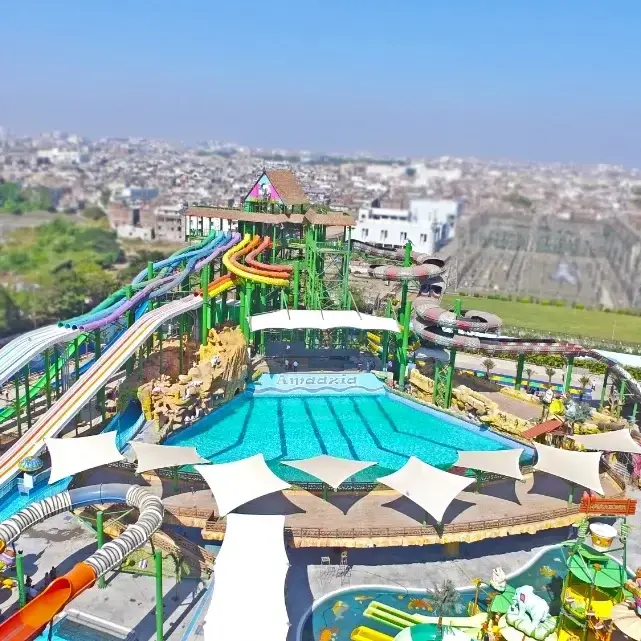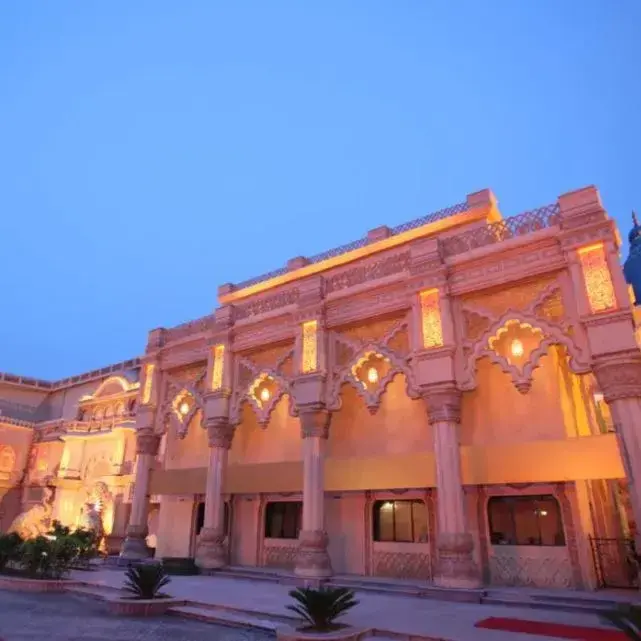
A township is not a building. It is a world.
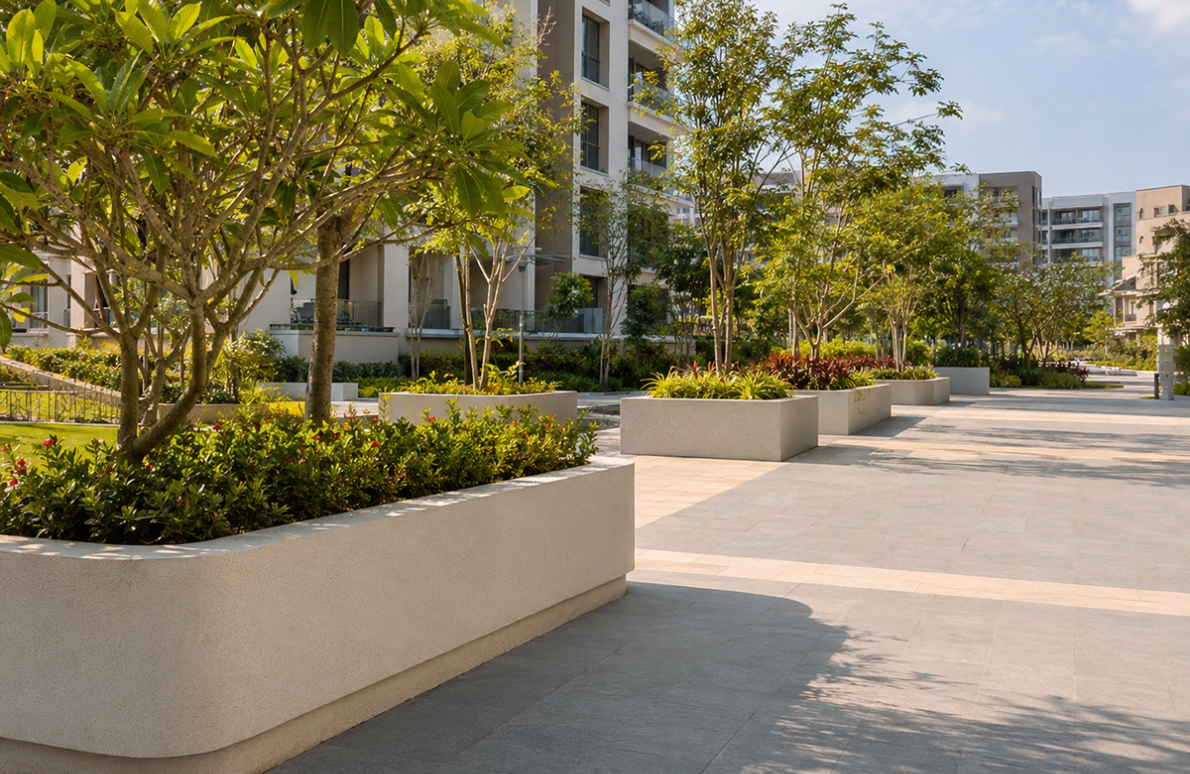
Hundreds of residences, retail streets, clubhouses, garden avenues, water features, central parks and pedestrian promenades - all designed to work together as a place where people want to live, spend time and bring their families. The landscape is not an afterthought in a well-designed township. It is the connective tissue that makes the whole thing feel like somewhere worth being.
And at that scale - hundreds of planters across kilometres of landscape area - the material they are made from matters enormously. Not just for aesthetics. But for how the landscape ages, how much it costs to maintain and whether it still looks like it did on inauguration day five years down the line.
At DECO, we manufacture GRC planters for township and integrated development landscapes across India. This is a practical look at why GRC is the right material for large-scale landscape planter specification - and what developers and landscape architects need to consider when specifying at this scale.
GRC Planters for Large Landscapes - Why Scale Changes Everything
Why Large-Scale Landscape Specification Is a Different Conversation
Specifying a planter for a single courtyard and specifying planters for a three-hundred-acre integrated township development are not the same conversation.
At township scale, every decision multiplies. A maintenance problem that affects one planter in a small project affects three hundred planters in a township. A surface quality inconsistency that is barely visible on a single unit becomes a very visible pattern across an entire landscape avenue. And the cumulative cost of replacing or repairing planters that were underspecified for the conditions becomes a significant facilities management burden across the life of a development.
This is why the GRC planter specification conversation on large township and integrated development projects tends to be driven by developers and landscape architects who have already experienced what happens when the wrong material is chosen at scale. Stone planters that stain and develop biological growth across the monsoon seasons. Metal planters that corrode at welded joints. Standard concrete planters that crack and spall over repeated thermal cycling in Indian outdoor conditions.
GRC planters address every one of these failure modes - which is why they have become the default specification on serious township and integrated development landscape projects across India.
What GRC Delivers for Township and Integrated Development Landscapes
Consistent Quality Across Hundreds of Units
A township landscape might require two hundred, five hundred or even more individual planters - across entrance avenues, garden promenades, clubhouse surrounds, residential streetscapes and amenity spaces. Every planter needs to match every other planter in its zone.
GRC is a factory-manufactured material. DECO GRC planters are produced under controlled conditions with dimensional tolerances and surface finish consistency maintained across the full production run. Whether a township requires fifty identical entrance planters or three hundred garden promenades planters, every unit matches - in form, surface texture and color. This consistency is simply not achievable with stone, where natural variation between quarry batches affects colour and texture across large quantities, or with standard precast concrete, where surface quality varies between pours.
Surface Quality That Ages Well in Indian Conditions
Indian outdoor conditions are demanding - monsoon rainfall, intense UV exposure, high humidity through summer and in many township locations, hard water from irrigation systems that leaves mineral deposits on planter surfaces over time.
DECO GRC planters have a low porosity surface that resists moisture absorption, staining and biological growth more effectively than stone or standard concrete. Moss, algae and the organic staining that accumulates on porous surfaces in humid Indian conditions take hold much less readily on GRC. The result is a landscape that requires less cleaning intervention to maintain its appearance - a meaningful operational advantage when the landscape team is managing hundreds of planters across a large site.
Design Flexibility for Complex Master Planned Landscapes
Township and integrated development landscapes are master planned environments - where the planter form, scale and finish are part of a deliberate design language that runs through the entire site. The entrance avenue has a different character from the central park. The clubhouse garden reads differently from the residential streetscape. Each zone has its own planter specification within the overall design vocabulary.
DECO manufactures GRC planters in custom profiles, sizes and finishes - allowing each zone of a township landscape to have its own planter character while the underlying material quality and manufacturing standard remains consistent throughout. This design flexibility within a single material system is what allows township landscapes to feel considered rather than generic.
Long Term Durability Without Ongoing Replacement Cycles
At township scale, replacement of deteriorated planters is not a simple operation. It involves procurement, logistics, installation disruption to the landscape and often visual inconsistency between old and new units if the original material or finish is no longer available in exactly the same specification.
DECO GRC planters are designed for a service life that extends across the full life of the development. The material does not rust, rot, crack under normal thermal cycling or require periodic surface treatment to maintain its integrity. For township developers and facilities management teams planning landscape maintenance budgets across a twenty or thirty year development lifespan - this durability without replacement cycles is a real and significant cost advantage.
Landscape strategy note: On large township developments, DECO recommends developing a zone-by-zone GRC planter specification - different profiles and finishes for entrance, residential, amenity and commercial zones - within a coordinated production programme that maintains manufacturing consistency across the full site.
Township Landscape Zones - How DECO GRC Planters Are Specified
Frequently Asked Questions - GRC Planters for Township Landscapes
Q1. Why are GRC planters preferred over stone planters for large township landscapes?
At township scale, stone planters create three consistent problems - surface staining and biological growth in Indian monsoon conditions, colour variation between quarry batches that affects consistency across hundreds of units, and high weight that complicates installation logistics across large sites. DECO GRC planters address all three - low porosity surface resists staining, factory production ensures complete consistency across the full quantity, and the lighter weight simplifies installation and repositioning across large landscape areas.
Q2. Can DECO manufacture GRC planters in different specifications for different zones of a township?
Yes. DECO develops zone-by-zone GRC planter specifications for township and integrated development projects - different profiles, sizes and finishes for entrance, residential, amenity and commercial zones - within a coordinated production programme. All zones are manufactured to the same material quality and surface finish standard, ensuring the development reads as a coherent landscape rather than a collection of unrelated planter types.
Q3. How do DECO GRC planters perform across Indian outdoor conditions over time?
DECO GRC planters are manufactured for long-term performance in Indian outdoor conditions - monsoon rainfall, high UV exposure, high humidity and hard water from irrigation systems. The low porosity surface resists moisture absorption, staining and biological growth. The alkali-resistant glass fibre reinforcement prevents surface cracking under thermal cycling. DECO GRC planters maintain their surface quality and structural integrity across Indian seasons without the periodic surface treatment or replacement cycles that other materials require.
Q4. What is the lead time for large quantity GRC planter orders for township projects?
Lead time for large quantity DECO GRC planter orders depends on total quantity, number of distinct specifications and production phasing requirements. DECO typically works to a phased production and delivery programme on township projects - coordinated with the landscape installation sequence across different zones. Initial mould development and sample approval takes 6 to 8 weeks before phased production begins. DECO recommends early engagement at the landscape design stage to programme production in line with the site's landscape installation schedule.
Q5. Does DECO supply GRC planters for integrated development projects across India?
Yes. DECO supplies GRC planters for township and integrated development landscape projects across India - including large residential townships, mixed use integrated developments, resort and hospitality landscapes and commercial campus environments. Design, manufacturing and phased delivery are all managed in-house. DECO works with landscape architects, project management teams and developers from the specification stage through to full landscape installation completion.
Conclusion - The Right Planter for the Scale of the Development
A township or integrated development landscape is one of the most demanding landscape specifications in Indian construction - not because any individual element is technically complex, but because every decision has to work at scale, age consistently and remain maintainable across the full life of a development that hundreds or thousands of families will call home.
GRC planters deliver on all three counts. Consistent manufacturing quality across hundreds of units. Surface performance that holds up across Indian outdoor conditions without intensive maintenance. Design flexibility that allows each zone of a township landscape to have its own character within a coherent overall specification.
DECO manufactures GRC planters for township and integrated development landscapes across India - from initial zone-by-zone specification development through to phased production and delivery coordinated with the landscape installation programme. The right landscape starts with the right planter specification - and that conversation starts early.
Specify DECO GRC Planters for Your Township or Landscape Project
Share your landscape drawings, planter requirements and project timeline.
DECO responds with a written technical recommendation.