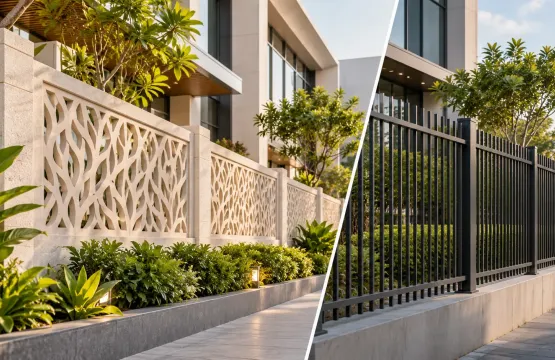
A successful retail street is more than a row of shops.
It is an environment where architecture, movement, greenery and public interaction come together. From high-street shopping destinations and mixed-use developments to lifestyle retail complexes, the spaces between storefronts are just as important as the shops themselves.
Well-designed retail streetscapes encourage people to explore, pause and experience their surroundings comfortably.
Among the architectural elements that contribute to these environments, GRC planters play an important role.
They introduce greenery, define pedestrian routes, create visual separation and enhance storefront entrances without relying on permanent walls or heavy landscape structures.
DECO GRC Planters by The Global Elephant combine durable material construction, refined geometry and customizable finishes, making them suitable for modern retail streetscapes and commercial landscape developments in India.
GRC Planters for Retail Streetscapes - At a Glance
Green Buffers | Pedestrian Walkways | Entrance Definition | Architectural Landscape Design
Why Retail Streetscapes Need Thoughtful Landscape Design
Retail streets differ from conventional shopping malls.
They often combine open-air pedestrian areas, storefront entrances, outdoor seating, café extensions, landscaping and vehicle access within a shared environment.
These different activities require careful spatial planning.
A retail walkway must remain open and accessible. Storefronts should be clearly visible. Outdoor seating areas need separation without becoming enclosed, while landscaping should contribute to the overall atmosphere.
GRC planters help organize these functions through architectural placement.
Instead of introducing solid partitions, planters create softer boundaries using greenery and carefully designed forms.
The result can be a retail environment that feels structured, welcoming and visually connected.
Creating Green Buffers Along Retail Streets
Separating Pedestrian and Vehicle Zones
Many retail streetscapes include pedestrian pathways alongside internal roads, parking lanes or drop-off areas.
Landscape planters can help define the visual boundary between these zones.
Long rectangular GRC planters or repeated planter arrangements can introduce greenery along walkway edges, making the transition between pedestrian and vehicle areas more apparent.
However, ordinary architectural planters should not be treated as vehicle-impact barriers unless specifically engineered and certified for that purpose.
Their primary role is to support landscape organization and visual separation.
Greenery Along Storefront Edges
Retail developments often feature continuous glazing, signage and hard paving surfaces.
GRC planters can soften these architectural materials by introducing natural planting along the street.
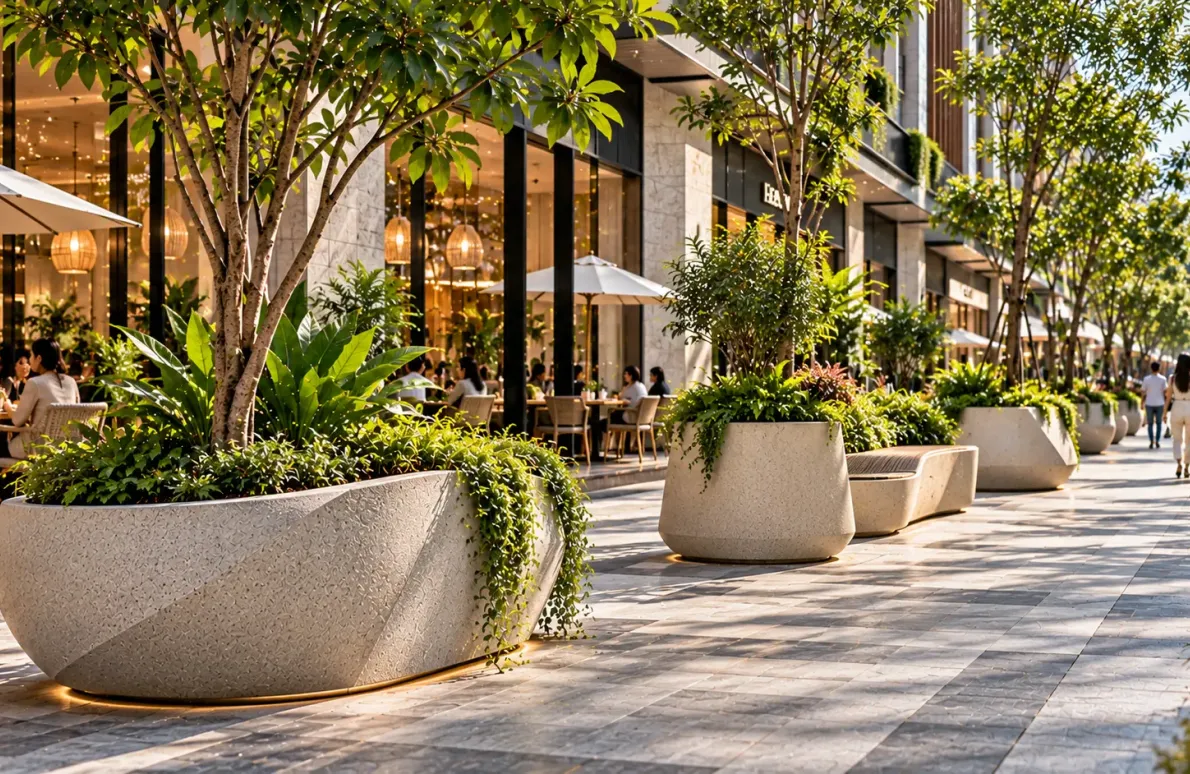
Low-profile planters may be positioned near appropriate storefront edges, while larger sculptural forms can become landscape features at wider pedestrian nodes.
Careful placement ensures that greenery enhances the retail environment without obstructing shop visibility.
Defining Outdoor Dining Zones
Restaurants and cafés within retail streets frequently extend into outdoor seating areas.
Architectural planters can establish gentle boundaries around these spaces while maintaining visual openness.
When combined with coordinated paving, lighting and furniture, GRC planters help create attractive and comfortable outdoor dining environments.
GRC Planters for Pedestrian Walkway Design
Pedestrian comfort is central to successful retail streetscape planning.
Walkways should support movement, accessibility, window shopping and informal interaction without becoming cluttered.
GRC planters can contribute to walkway design through carefully planned placement.
Creating Visual Rhythm
Repeated planter forms can establish a consistent landscape rhythm along long pedestrian streets.
Using coordinated dimensions, finishes and planting arrangements helps create visual continuity between different retail blocks.
This approach can be particularly effective in mixed-use developments where multiple storefronts share a common architectural language.
Landscaping Wider Pedestrian Areas
Wide walkways often provide opportunities for landscaped pockets, informal seating and gathering spaces.
GRC planters can help define these areas without interrupting the main circulation route.
Sculptural planter forms may also introduce focal points at pedestrian intersections or wider public spaces.
Maintaining Clear Movement
Planters should never compromise pedestrian accessibility.
Their location must allow adequate clear walkway width, wheelchair movement, emergency access and visibility around entrances.
Thoughtful placement ensures that landscape design improves the retail experience rather than becoming an obstruction.
Enhancing Retail Entrances with GRC Planters
The entrance of a retail property plays an important role in establishing its identity.
Whether it is a flagship showroom, boutique store, shopping arcade or lifestyle retail development, the arrival experience influences how visitors perceive the space.
GRC planters can help frame entrances and create a more refined transition from the street into the building.
Statement Planters for Flagship Stores
Large architectural planters can introduce symmetry, greenery and visual emphasis around prominent retail entrances.
Their scale and surface finish should complement the storefront architecture rather than compete with signage or merchandise displays.
Planter Groupings for Retail Courtyards
For retail developments with internal courtyards or landscaped entrance courts, grouped planters can create attractive focal points.
Different heights and shapes may be combined to introduce variation while maintaining a coordinated design language.
Integrating Landscape with Building Façades
Planters are most effective when their form and finish relate to the surrounding architecture.
A planter finish that complements façade panels, paving and entrance detailing can create a cohesive exterior composition.
This allows the landscape to feel like an integrated part of the retail development rather than an added decorative feature.
Why GRC Works for Retail Landscape Applications
GRC, or Glass Reinforced Concrete, is a composite material suitable for architectural elements requiring detailed forms and durable exterior performance.
For retail streetscapes, GRC offers several advantages.
Design Flexibility: GRC can be moulded into customized geometric, curved and sculptural planter shapes.
Durability: Properly manufactured GRC planters are suitable for outdoor conditions involving sunlight, rainfall and regular public use.
Weight Efficiency: GRC can provide reduced self-weight compared with comparable solid concrete elements, depending on design and dimensions.
Consistent Finishes: Coordinated surface treatments can maintain a consistent landscape appearance across large commercial developments.
Custom Sizes: Planter dimensions and configurations can be developed according to the project's architectural and landscape requirements.
These qualities make GRC useful where landscape elements must provide both functionality and visual refinement.
DECO GRC Planter Shapes and Finishes
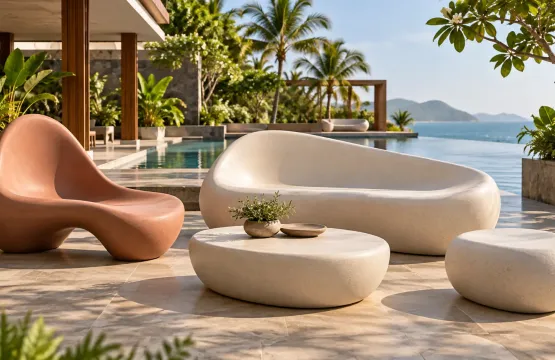
DECO's architectural planter range includes sculptural forms such as Capsule Planters, Pebble Planters and Oasis Island configurations.
These products can be considered for appropriate retail landscape locations depending on their dimensions, functions and site requirements.
For larger retail developments, project-specific planter sizes and arrangements can also be explored.
DECO GRC Planters feature material finishes including:
- Concrete
- Terrazzo
- Travertine
- Sandstone
- Granite
Custom finishes may be developed for specific project requirements.
For contemporary retail streets, smooth concrete or terrazzo-inspired finishes can complement modern façades.
Stone-inspired finishes may suit landscaped high-street developments and outdoor lifestyle destinations.
The finish should be selected according to the overall architecture, expected weather exposure and maintenance requirements.
Where GRC Planters Can Be Used in Retail Streetscapes
| Retail Application | Design Approach |
|---|---|
| High-Street Walkways | Repeated architectural planters defining landscape edges |
| Storefront Entrances | Statement planters framing retail arrival areas |
| Outdoor Café Zones | Green planter arrangements defining dining boundaries |
| Pedestrian Nodes | Sculptural planters creating landscape focal points |
| Mixed-Use Retail Streets | Coordinated planter systems connecting multiple buildings |
| Retail Courtyards | Grouped architectural planters integrated with paving and seating |
Important Specification Considerations
GRC planters should be selected according to the physical and operational requirements of the retail environment.
Pedestrian Accessibility: Planters must not obstruct accessible routes, entrances, tactile guidance surfaces or emergency circulation.
Planter Dimensions: Size and proportion should suit the width of the walkway and the intended planting.
Structural Loading: The combined weight of the planter, saturated soil, retained water and vegetation should be evaluated, particularly on podium slabs.
Drainage: Proper drainage and overflow provisions are essential to prevent water accumulation and staining of adjacent paving.
Plant Selection: Plants should suit local sunlight, wind exposure, irrigation and maintenance conditions.
Placement and Stability: Freestanding planters should remain stable during public use and foreseeable site conditions.
Maintenance: Cleaning, watering, drainage inspection and plant replacement access should be considered during planning.
These details help ensure that retail landscaping remains attractive, functional and manageable over time.
Frequently Asked Questions
Q1. Why are GRC planters suitable for retail streetscapes?
GRC planters offer design flexibility, durability and architectural finish options.
They can introduce greenery, organize landscape areas and complement modern retail environments while providing project-specific visual character.
Q2. Can GRC planters be used along pedestrian walkways?
Yes. GRC planters can be positioned along walkways to create green edges and landscape rhythm.
However, their placement should preserve accessible circulation widths, storefront access and emergency movement.
Q3. Can DECO GRC Planters be customized?
Yes. DECO offers architectural planter solutions with custom sizes, configurations and finish possibilities.
Customization allows landscape designers to coordinate planters with the overall retail architecture.
Q4. What finishes are available for DECO GRC Planters?
DECO's planter range includes Concrete, Terrazzo, Travertine, Sandstone and Granite finishes.
Custom finishes can also be explored based on project requirements.
Q5. What should architects consider before specifying GRC planters for retail streets?
Important considerations include planter dimensions, circulation requirements, drainage, structural loading, stability, plant selection and maintenance access.
These should be coordinated with the landscape and architectural design during the planning stage.
Creating Retail Streetscapes with Architectural Character
A well-designed retail street should encourage movement while offering comfortable places to pause, explore and interact.
Landscape elements help create this balance by introducing greenery, spatial definition and visual continuity.
GRC Planters for Retail Streetscapes provide a practical way to integrate these qualities into open-air commercial environments.
From green buffers and pedestrian walkways to storefront entrances and landscaped gathering areas, architectural planters help connect the retail experience with the surrounding built environment.
For architects, landscape designers and commercial developers, considering DECO GRC Planters during the early streetscape planning stage can help coordinate pedestrian circulation, landscape design, planter geometry and material finishes into one cohesive architectural environment.