A luxury resort or private villa is judged at a level most buildings never face.
The guest who arrives expecting a premium experience evaluates everything - the arrival sequence, the interplay of light and shade in the corridors, the way a breeze moves through the room, the view from the private pool terrace and crucially, whether that view is shared with anyone they did not invite.
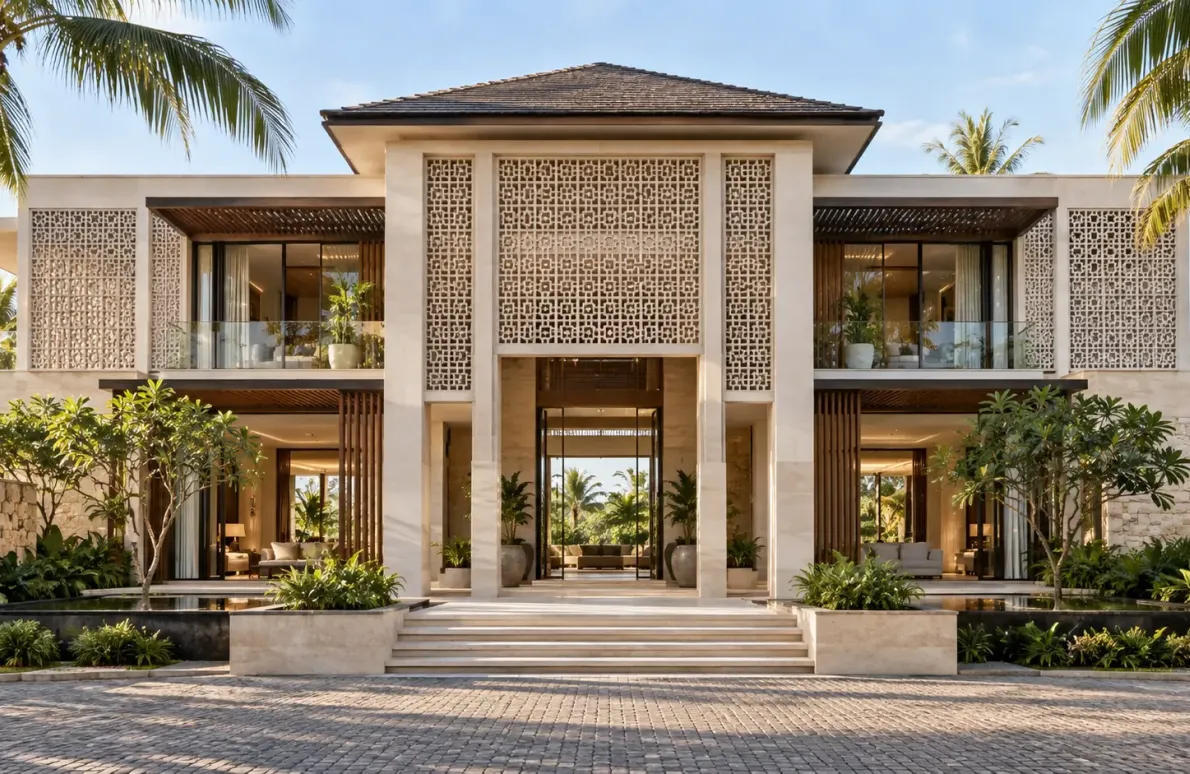
Privacy, ventilation and design character are not separate concerns in resort and villa architecture. They are the same concern - the quality of the spatial experience. And increasingly, the architectural element delivering all three simultaneously on premium hospitality and villa projects across India is the GRC Jali screen.
At DECO, we manufacture GRC Jalis for resort, hotel and villa projects across India - from coastal properties in Goa and Kerala to hill resort developments in the Western Ghats and premium villa communities in Rajasthan and Gujarat. This blog explains how GRC Jali screens solve the specific challenges of resort and villa architecture - and what architects and hospitality developers need to know to get the specification right.
GRC Jali in Resort and Villa Architecture - At a Glance
Why Resort and Villa Architecture Has Unique Facade Demands
Resort and villa architecture operates under a set of design constraints that commercial office or residential buildings do not face in the same way.
Privacy is the primary one. A resort guest paying a premium rate for a pool villa or a private suite has an expectation of complete visual privacy from adjacent villas, from staff circulation routes and from public areas. This expectation is absolute - and it needs to be delivered without making the private space feel enclosed or cut off from the landscape and sky that are the resort's primary assets.
Ventilation is the second. Premium resort design in India increasingly moves away from sealed, fully air-conditioned spaces toward naturally ventilated environments that allow guests to experience the outdoor climate - the sea breeze, the mountain air, the fragrance of the landscape - from within the covered spaces of the resort. This passive ventilation approach requires facade elements that allow air movement while maintaining the privacy the guest expects.
Design character is the third. A resort or villa development creates a sense of place through its architecture - a design language that is specific to this location, this landscape and this brand. The facade elements that carry this language need to be custom rather than generic. A Jali screen pattern that is specific to this resort gives the property a visual identity that guests remember and that distinguishes the property from competitors in the same category.
GRC Jalis address all three demands in a single manufactured element - which is why they have become a defining feature of premium resort and villa architecture across India.
How GRC Jali Screens Deliver Privacy in Resort Settings
Pool Villa Privacy Screens
The pool villa is the defining accommodation typology of premium resort development in India. The private plunge pool or lap pool surrounded by open-air living space is the core guest experience proposition - but it only works as a premium experience if the privacy from adjacent villas and from public circulation is absolute.
A GRC Jali screen on the boundary of a pool villa enclosure solves this problem in a way that a solid wall cannot. The screen provides complete visual privacy at standing and seated eye levels - guests outside the villa cannot see into the private space - while allowing natural light, sky views and cross ventilation to pass through. The enclosure feels open rather than claustrophobic. The guest experiences the landscape without being exposed to it.
DECO works with resort architects to calculate the openness ratio and pattern geometry of GRC Jali screens for pool villa applications - ensuring the privacy requirement is met at the relevant viewing angles while the ventilation and light quality inside the enclosure are maintained.
Room Balcony and Corridor Privacy
In resort buildings where guest rooms or suites share a corridor or have balconies that overlook adjacent spaces, GRC Jali screens between balconies or along corridor edges create privacy between guests without closing off the space. The Jali screen allows light and air to pass through - the corridor remains a pleasant transition space rather than a dark enclosed tunnel - while preventing direct visual access between adjacent balconies or from the corridor into the room.
Villa Compound Boundary Screens
For private villa developments - standalone villas or villa communities - the compound boundary is where the privacy specification starts. A solid wall delivers privacy but creates an institutional feeling that is the opposite of the premium residential experience the villa is designed to provide. A GRC Jali screen boundary wall delivers privacy from the road and from adjacent properties while giving the villa a design character from the exterior that communicates quality and architectural intent from the approach.
Design note for resort Jali specification: The openness ratio of the GRC Jali screen - the proportion of open to solid - determines both the privacy level and the ventilation performance. A screen that is too open compromises privacy. A screen that is too solid reduces ventilation and creates a heavier visual presence. DECO calculates the openness ratio for each specific application based on the viewing angles, distances and privacy requirement of the project.
How GRC Jali Screens Contribute to Natural Ventilation in Resorts
The move toward naturally ventilated resort architecture in India is both an environmental aspiration and a guest experience decision. Guests who choose premium resort destinations in coastal Goa, the Kerala backwaters, Rajasthan or the Western Ghats are choosing those locations specifically for the outdoor experience - the climate, the landscape, the sensory quality of being somewhere specific.
Sealed, fully air-conditioned resort spaces deny guests this experience. The most successful premium resort developments in India use architecture to mediate between the interior and the outdoor environment - allowing guests to experience the outdoor climate from the comfort of covered spaces rather than from either a sealed box or direct exposure.
GRC Jali screens are one of the primary architectural tools for achieving this mediation. A Jali screen on the windward face of a resort pavilion or villa allows prevailing breezes to pass through the pattern openings into the covered space while providing the shade and visual screening the space requires. The guest experiences the outdoor air without direct sun exposure or loss of privacy.
In coastal resort locations where sea breezes are a significant part of the ambient environment, GRC Jali screens on the sea-facing elevations of resort buildings capture these breezes and direct them through the building - reducing the dependence on mechanical cooling and connecting the interior experience directly to the outdoor coastal environment that makes the location desirable.
GRC Jali as a Design Character Element in Resort Architecture
Pattern as Place Identity
The most memorable resort properties in India have a design language that is specific to their location and their brand. A resort in Rajasthan references the geometric lattice work of Rajasthani haveli architecture. A coastal resort in Goa draws on Portuguese architectural heritage. A hill resort in the Western Ghats references the natural forms of the landscape around it.
The GRC Jali pattern is one of the most powerful tools available to resort architects for expressing this place identity at the facade level. A custom pattern developed specifically for the resort - derived from local architectural tradition, from the landscape character or from the resort's own brand language - gives the property a face that is immediately recognisable and impossible to replicate elsewhere.
DECO works with resort architects and hospitality brand teams to develop GRC Jali patterns that carry genuine place identity rather than generic decorative interest. The pattern development process starts with the design brief - what does this resort want to communicate about its location, its heritage and its character - and ends with a manufactured screen that delivers that communication in every panel installed across the property.
Light and Shadow as Guest Experience
The way a GRC Jali screen filters sunlight is as much a design element as the pattern itself. The shadow pattern cast by a Jali screen onto the floor, wall or pool surface of a resort space changes through the day as the sun moves - creating an animated, living quality to the filtered light that is one of the most sensory experiences a resort architecture can deliver.
This light quality is particularly valuable in resort settings because it connects the interior experience directly to the outdoor environment and the passage of time. A guest lying beside a pool filtered by a Jali screen experiences the afternoon light differently from the morning light - without moving, they are aware of the landscape, the time of day and the specific quality of the location they have chosen to visit.
Where DECO GRC Jalis Are Specified in Resort and Villa Architecture
Frequently Asked Questions
Q1. Are GRC Jali screens suitable for coastal resort locations in India?
Yes. DECO GRC Jali screens are manufactured with alkali-resistant glass fibres and tested for coastal salt air exposure - making them specifically suitable for resort and villa projects in coastal locations including Goa, Kerala, Maharashtra, Tamil Nadu and Andhra Pradesh. The low porosity surface resists moisture absorption and biological growth in high humidity coastal environments. All exterior GRC Jali fixing components are stainless steel as standard - eliminating corrosion at connection points in coastal conditions.
Q2. Can DECO develop a custom GRC Jali pattern that references the local architectural heritage of the resort's location?
Yes. Heritage-referencing pattern development is one of DECO's most common resort Jali briefs. Rajasthani geometric lattice, Kerala traditional screen patterns, Mughal-inspired geometric work, Portuguese-influenced patterns for Goa - DECO develops custom GRC Jali patterns from the architect's design references and location context. The pattern development process translates the heritage reference into a contemporary manufactured screen that carries genuine place identity without literal reproduction.
Q3. How does DECO calculate the right openness ratio for a resort GRC Jali privacy screen?
Openness ratio calculation for resort privacy screens considers the viewing distance from the exterior, the eye level angles at which privacy needs to be maintained, the orientation of the screen relative to sun and prevailing wind, and the architect's design intent for the quality of filtered light inside the space. DECO provides openness ratio recommendations based on these parameters for each specific application - typically presented with the pattern concept for the architect's review and approval.
Q4. What GRC Jali screen finishes are best suited to resort and villa architecture?
Natural and warm surface finishes typically suit resort and villa architecture - sand-faced, fine textured and custom pigmented finishes in warm tones that complement natural landscape materials. DECO produces physical sample panels for finish review before full production - allowing the design team to select the finish that best complements the resort's material palette in the actual material rather than from a chip sample or digital reference.
Q5. Can GRC Jali screens be used in coastal resort locations where monsoon rainfall is heavy?
Yes. DECO GRC Jali screens are manufactured for the full range of Indian outdoor conditions including heavy monsoon rainfall. The low porosity surface does not absorb rainwater - it drains from the screen surface quickly without staining or biological growth accumulation. The alkali-resistant glass fibre reinforcement maintains structural integrity under repeated wet-dry cycling. DECO GRC Jali screens on coastal resort properties in Kerala, Goa and Maharashtra have demonstrated reliable performance across multiple monsoon seasons.
The Element That Makes a Resort Feel Like Somewhere
The difference between a resort that guests return to and one they visit once is often not the amenities. It is the quality of the spatial experience - the way light moves through the spaces, the way privacy feels natural rather than imposed, the way the architecture communicates something specific about where the resort is located and why that location matters.
GRC Jali screens deliver this quality in resort and villa architecture more completely than almost any other single architectural element. They solve the privacy requirement without enclosing the space. They allow ventilation that connects guests to the outdoor environment. And they carry the design character that makes the resort feel like somewhere specific rather than anywhere premium.
DECO manufactures GRC Jalis for resort and villa projects across India - from pattern concept development through to manufactured installation. Every resort Jali project starts with a conversation about what the screen needs to achieve for the guest experience and ends with a manufactured screen that delivers it precisely across the full life of the property.