GRC Jaali for Commercial Facades - Design Guide for Architects and Builders
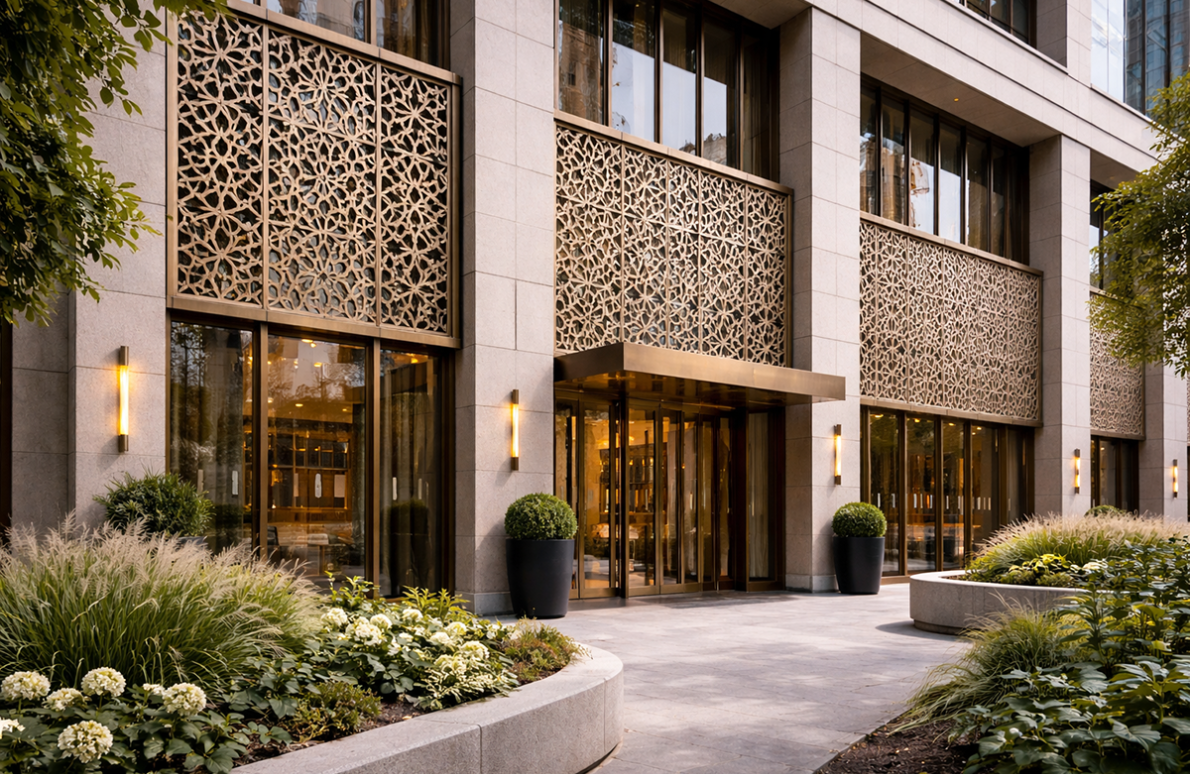
Walk past any significant commercial building completed in India in the last five years and there is a good chance you will see a Jaali screen somewhere on its facade. Hotels, corporate offices, hospitals, mixed use developments — the Jaali has made a very strong comeback in contemporary Indian architecture. And the material driving most of that comeback is GRC.
The Jaali is not a new idea. It goes back centuries in Indian and Islamic architectural tradition — perforated stone screens that filtered light, created privacy and kept interiors cool long before air conditioning existed. What has changed is the material it is made from and the scale at which it can now be applied.
At DECO, we manufacture architectural Jaalis for commercial facades across India — working with architects, builders and developers from design development through to installation. The questions we get asked most often by the project teams we work with are the same ones this guide is written to answer. What makes GRC the right material for exterior Jaali screens? How do you design one that actually performs? What does a builder need to know before specifying it?
This is a practical design guide — not a product brochure. It is written for the people who have to make real decisions on real projects.
What Is a GRC Jaali and Why Is It Used on Commercial Facades?
A Jaali is essentially a perforated screen — a surface with a pattern of openings cut through it. Traditionally these were carved from stone. Today, the most widely specified material for exterior Jaali screens on commercial buildings in India is GRC — Glass Reinforced Concrete.
GRC is a composite material made by combining cement, fine sand and alkali-resistant glass fibres. The result is a material that looks and feels like concrete but is significantly lighter, can be cast into very thin sections and holds fine detail with precision. For Jaali screens specifically — where the pattern, the edge quality and the consistency across multiple panels all matter — GRC delivers what stone carving cannot at commercial scale.
GRC Jaalis are used on commercial facades for a combination of reasons that go well beyond aesthetics. They shade the building from direct sun. They allow natural ventilation through the facade. They create privacy on balconies and in semi-public spaces without completely closing off views or light. And they give a building a strong visual identity from the street — which matters commercially for hotels, offices and retail developments.
What makes GRC particularly well suited to this application is that it achieves all of these functional outcomes while giving the design team complete freedom over pattern, form and finish. The same material can produce a geometric Islamic-inspired lattice, a contemporary abstract pattern or a custom design that references the client's brand identity. And it can produce that pattern consistently across hundreds of panels on a large commercial project — which hand-carved stone simply cannot do at any reasonable cost or timeline.
Why Exterior GRC Jali Outperforms Other Materials for Commercial Projects
Architects specifying Jaali screens for exterior commercial facades have a few material options. Stone, precast concrete, aluminium, and GRC are the most commonly considered. Each has a place — but for the combination of performance, design freedom and project efficiency that commercial buildings demand, exterior GRC Jali consistently comes out ahead.
Weight and Structural Load
Stone Jaali screens are extremely heavy. On a commercial building where the Jaali is being used as a secondary facade element — attached to the structure rather than being the structure itself — that weight adds up very quickly across a large facade area. GRC Jaali panels weigh a fraction of equivalent stone panels. GRC Jaali screens are typically cast at 20 to 25mm thickness, achieving structural integrity at a weight that stone cannot match in thin sections.
Pattern Precision and Consistency
On a commercial project you might need 200 or 300 identical Jaali panels. Stone carving at that volume introduces variation — natural material inconsistencies, hand carving differences, color variation between quarry batches. GRC is a cast material. Every GRC Jaali panel produced from the same mould is consistent in dimension, pattern precision and surface quality. For commercial buildings where the facade is a deliberate visual statement, that consistency matters enormously.
Weather and Durability on Indian Facades
An exterior GRC Jali on a commercial building in India has to survive monsoon rainfall, intense summer heat, UV exposure and in coastal locations, salt air. GRC handles all of these conditions reliably. The alkali-resistant glass fibres prevent the kind of surface cracking and spalling that standard concrete shows over time. GRC Jaali panels maintain their surface quality and structural integrity across the full range of Indian climate conditions without the maintenance burden that stone surfaces require.
Installation Speed
Commercial construction in India runs on tight programme schedules. GRC Jaali panels are lightweight, pre-manufactured to precise dimensions and can be installed quickly by a trained team. The lightweight nature of the panels reduces the crane and lifting equipment requirements compared to stone — which directly affects installation cost and programme on large facades.
Designing an Exterior GRC Jali — What Architects Need to Know
The design process for a GRC Jaali screen on a commercial facade involves decisions at several levels — pattern, panel sizing, thickness, fixing system and finish. Getting these right early in the design process avoids the costly revisions that happen when Jaali design is left too late.
Pattern Design
The pattern is the most visible design decision but it should not be made in isolation from the functional requirements of the Jaali. The openness ratio — the proportion of the panel that is open versus solid — directly affects how much light and air passes through. A highly open pattern maximises ventilation and light penetration but provides less solar shading and less privacy. A denser pattern provides more shading and privacy but reduces the sense of openness behind it.
For commercial facades in hot Indian climates, an openness ratio of 30 to 50 percent is a common working range — enough openness to allow ventilation and avoid a heavy visual mass, enough solid material to meaningfully reduce solar heat gain on the facade behind.
DECO works with architects at the pattern development stage to translate design intent into a GRC-manufacturable Jaali pattern — ensuring that the geometry works structurally in the material, that the minimum section sizes between openings are maintained and that the pattern reads correctly at the scale of the overall building facade.
Panel Sizing
Panel size is a coordination decision between the design team, the structural engineer and the manufacturer. Larger panels mean fewer joints on the facade — a cleaner visual result. But larger panels are heavier, require more careful handling and are more sensitive to differential movement in the fixing system. DECO GRC Jaali panels for commercial facades typically range from 600mm x 600mm for fine pattern screens to 1200mm x 2400mm for larger format applications — though custom sizes outside this range are manufactured regularly depending on project requirements.
Thickness and Structural Performance
GRC Jaali panel thickness for exterior commercial applications is typically between 20mm and 30mm depending on panel size, openness ratio and wind load requirements. Thinner sections are achievable with GRC in ways that standard concrete cannot manage — but the minimum section size between pattern openings has to be maintained to ensure the panel holds structural integrity under wind load and handling.
DECO's engineering team calculates panel thickness and reinforcement requirements for each project based on panel dimensions, openness ratio, wind zone and fixing system — ensuring every GRC Jaali panel meets the structural requirements of its specific installation.
Surface Finish Options
GRC Jaali panels for commercial facades are available in a range of surface finishes. Natural grey GRC with a smooth or lightly textured surface is the most commonly specified finish for contemporary commercial architecture. Sand faced finishes give a warmer, more tactile quality. Pigmented finishes in custom colors allow the Jaali to carry a specific color palette that ties to the building's overall material strategy. Exposed aggregate finishes create a richer surface texture that reads well at close range on lower level facade applications.
Fixing Systems for GRC Jaali on Commercial Facades
The fixing system is the most technically critical aspect of GRC Jaali specification on commercial facades — and it is the area where decisions made late in the design process most often create problems on site.
GRC Jaali panels on exterior commercial facades are typically fixed using one of three approaches — face fixed to a substrate, fixed to a secondary steel subframe, or integrated into a ventilated facade system. Each approach has specific structural, thermal and aesthetic implications.
Face Fixed to Substrate
The simplest approach — panels are fixed directly to the primary facade wall using stainless steel fixings cast into the GRC panel during manufacture. This works well for lower level applications and where the Jaali sits directly against the building surface. Movement joints between panels need to be carefully detailed to allow for thermal expansion without visible cracking at panel edges.
Secondary Steel Subframe
For larger format Jaali screens and applications where the Jaali is being used as a standalone facade element standing away from the primary building skin — a secondary steel subframe is the standard approach. The GRC panels fix to the subframe which transfers loads back to the primary structure. This system gives more design flexibility in terms of the gap between the Jaali screen and the building behind — allowing ventilation, maintenance access and the layered facade depth that creates strong shadow and light effects on the building's appearance.
Ventilated Facade Integration
In premium commercial applications, GRC Jaali panels are integrated into a full ventilated facade system — with a designed air cavity between the Jaali screen and the building's thermal envelope. This approach maximises the energy performance benefit of the Jaali screen by using the air cavity as a natural thermal buffer. DECO works with facade engineers and contractors on these more complex systems to ensure the GRC panel specification integrates correctly with the overall facade engineering.
What About UHPC and FRP Jaalis?
DECO also manufactures Jaali screens in UHPC — Ultra High Performance Concrete — and FRP — Fibre Reinforced Polymer — for projects where specific requirements point toward those materials.
UHPC Jaalis offer exceptional strength in very thin sections and are used on premium commercial and landmark projects where the highest surface quality and long term durability are the priority. FRP Jaalis are the lightest option and work well for interior applications, temporary installations and projects with very tight structural load constraints.
However, for standard exterior commercial facade applications across India — where the combination of weather performance, design flexibility, manufacturing consistency and installation efficiency matters most — GRC remains the most widely specified and most practical material choice. That is consistently what architects and builders working on commercial projects across India find when they evaluate the options.
What Builders Need to Know Before Specifying GRC Jaali
From DECO's experience working directly with builders and contractors on commercial projects across India, a few practical points consistently come up at the specification and procurement stage.
- Engage the GRC Jaali manufacturer early — pattern coordination, fixing design and structural calculations take time and affect other design decisions. Leaving Jaali specification to the finishing stages of a project creates programme pressure and limits design options.
- Clarify the fixing system with the structural engineer before finalising panel sizes — the subframe design and primary structure connections need to be coordinated with the GRC panel specification from the beginning.
- Allow for movement joints in the panel layout — GRC Jaali facades on commercial buildings need properly designed movement joints at regular intervals to accommodate thermal expansion and building movement without cracking at panel edges.
- Specify stainless steel fixings for all exterior GRC Jaali applications — mild steel fixings corrode in Indian outdoor conditions and cause staining on GRC surfaces over time.
- Plan for panel access in the facade design — replacement of individual damaged panels should be possible without dismantling large sections of the facade. This is a long term maintenance consideration that is much easier to design in from the start than to retrofit.
GRC Jaali in Indian Commercial Architecture — Where the Industry Is Heading
The use of architectural Jaali India-wide has grown significantly over the last decade and that growth shows no sign of slowing. Several converging trends are driving continued demand for GRC Jaali on commercial facades.
Green building certification requirements are pushing more commercial developers toward passive shading strategies — and a well-designed exterior GRC Jali is one of the most effective and visually compelling ways to achieve meaningful solar shading on a commercial facade. As ECBC compliance becomes more consistently enforced on commercial projects across Indian cities, the Jaali's role as a performance element alongside its aesthetic role will only increase.
There is also a broader cultural shift in Indian commercial architecture toward designs that acknowledge and reinterpret traditional architectural vocabulary rather than defaulting to generic international glass-and-steel aesthetics. The Jaali sits at the intersection of that cultural conversation — it is simultaneously deeply rooted in Indian architectural history and completely compatible with contemporary commercial design language.
DECO sees this in the projects we are involved in across India. Architects are specifying GRC Jaalis not just because they look good — but because they solve real performance problems, they connect to a design language that resonates with Indian clients and they deliver a result that generic cladding materials simply cannot.
Frequently Asked Questions
Q1. What is the minimum section size for GRC Jaali patterns on commercial facades?
The minimum section size between pattern openings in a DECO GRC Jaali panel is typically 20 to 25mm for standard commercial facade applications. This ensures structural integrity under wind load and handling. Finer pattern geometries are achievable but require thicker overall panel sections and are evaluated case by case based on panel size and fixing system.
Q2. How are GRC Jaali panels fixed to a commercial building facade?
GRC Jaali panels are fixed using stainless steel fixings cast into the panel during manufacture. They can be face fixed to a substrate wall, fixed to a secondary steel subframe or integrated into a full ventilated facade system depending on the project requirements. DECO provides fixing design guidance and coordinates with the project's structural and facade engineers at the specification stage.
Q3. Can GRC Jaali patterns be fully customised for a specific commercial project?
Yes. DECO manufactures GRC Jaali screens in fully custom patterns developed in coordination with the project architect. Geometric patterns, organic forms, brand-referenced designs and reinterpretations of traditional Jaali motifs are all achievable. DECO works with the design team from pattern development through to mould manufacture and panel production.