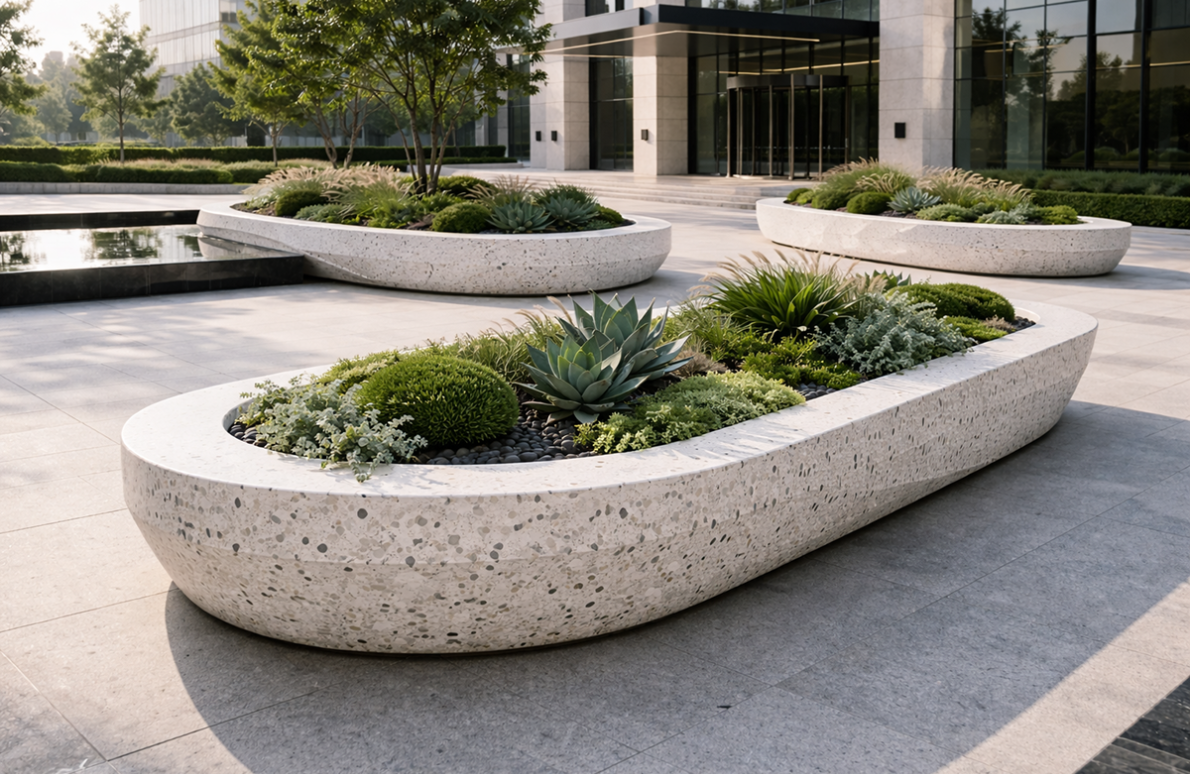
If you have visited a newly built hotel lobby, a corporate campus or a luxury residential development recently — you have probably walked past a planter without giving it a second thought. But what that planter is made from has changed significantly over the last few years. And the reason behind that change is worth understanding.
Traditional stone planters have been the default choice for decades. Heavy, solid, classic — they have lined building entrances and filled landscape designs across commercial and residential projects for as long as most people can remember.
But something is shifting. Architects, landscape designers and developers are increasingly specifying UHPC planters over traditional stone. Not because stone stopped looking good. But because UHPC — Ultra High Performance Concrete — solves real, measurable problems that stone simply cannot address.
At DECO, we manufacture architectural UHPC planters for projects across India — working directly with architects, builders and developers at the specification stage. What we hear consistently from the professionals we work with is that this shift is being driven by very practical reasons. This blog explains exactly what those reasons are.
What Is UHPC and Why Is It Different From Regular Concrete?
UHPC stands for Ultra High Performance Concrete. It is a concrete mix that has been engineered at a material level to be significantly stronger, denser and more durable than standard concrete or natural stone.
The mix includes fine aggregates, steel fibres, silica fume and a very low water-to-cement ratio. The result is a material with compressive strength several times higher than regular concrete — and a surface density that makes it almost completely impervious to water, chemicals and weather damage.
For planters specifically, this combination of properties changes what is possible both structurally and visually.
UHPC planters can be cast with wall sections as thin as 15 to 20mm and still handle soil load, water weight, root pressure and full outdoor exposure without any structural compromise. Standard concrete or stone needs significantly thicker sections to achieve comparable performance. That thickness difference directly drives the weight difference — which matters enormously on modern construction projects.
The Weight Problem With Traditional Stone
This is the conversation that comes up first on almost every project involving large planters — and it matters far more than most people initially realise.
Stone is structurally heavy. A large stone planter filled with soil and a mature plant can easily weigh several hundred kilograms. When you are placing these on a rooftop terrace, a podium level landscape, a raised deck or an elevated plaza — that weight has direct implications for the structural design of the building itself.
The structural engineer has to account for every kilogram of dead load sitting on the slab. More load means heavier structural design, more concrete, more reinforcement steel and higher overall project cost. On large developments with extensive landscape areas, the cumulative weight of traditional stone planters can push the structural design into a significantly more expensive bracket.
UHPC planters weigh up to 60 to 70 percent less than a stone planter of equivalent visual size. That weight saving is not a minor convenience — it has real financial value. It either reduces the structural cost of the slab directly or frees up load capacity for other design elements on the same level.
On podium and rooftop landscape projects in particular, specifying UHPC planters instead of stone creates measurable structural cost savings that often offset the material cost difference entirely.
Important note for project teams: Always calculate the cumulative dead load of landscape elements — including planters, soil, plants and water — early in the structural design process. Switching from stone to UHPC planters at this stage can significantly reduce slab design requirements.
Why UHPC Performs Better Than Stone in Indian Climate Conditions
India's climate puts outdoor materials through a demanding annual cycle — intense monsoon rainfall, high summer temperatures, humidity, and in some regions coastal salt air. Traditional stone handles some of these conditions reasonably well but it has known vulnerabilities.
Porous stone varieties absorb moisture. Over time this leads to surface staining, biological growth — moss, algae and lichen — and in areas with significant temperature variation, surface cracking as absorbed water expands and contracts. Softer stones chip and erode. The visual quality of a stone planter in an Indian outdoor environment can deteriorate noticeably within five to seven years without regular maintenance.
UHPC has an extremely low porosity by design. Water, salts, fertilisers and airborne pollutants have very limited ability to penetrate the surface. UHPC planters hold their surface quality significantly longer than stone in comparable outdoor conditions. The finish — whether smooth, polished or textured — does not fade, stain or erode the way natural stone surfaces do over time.
For coastal projects in cities like Mumbai, Chennai, Kochi or Goa — where salt air aggressively degrades many materials — DECO UHPC planters offer a level of durability that stone simply cannot match without intensive and costly maintenance.
Design Flexibility — What UHPC Makes Possible That Stone Cannot
Natural stone is a beautiful material. But it comes with the limitations of a material that has to be quarried, cut and shaped — processes that become exponentially more expensive as design complexity increases.
UHPC is a cast material. DECO manufactures UHPC planters using custom moulds — which means the shape, surface texture, finish and dimensions are all design decisions rather than material constraints. Curved profiles, tapered forms, sharp geometric edges, fine surface detailing — UHPC holds all of these cleanly and consistently across multiple units.
For architects and landscape designers who want planters to be genuine design elements — not just containers for plants — this design freedom is a significant practical advantage. DECO works directly with design teams to develop custom UHPC planter forms that carry the architectural language of a project into the landscape.
Surface finish options for architectural UHPC planters include smooth, polished, exposed aggregate, bush hammered and custom textured finishes. Color can be introduced through integral pigmentation — meaning the color runs through the full depth of the material rather than sitting as a surface coating that can chip or fade.
What About GRC and FRP Planters?
DECO also manufactures planters in GRC (Glass Reinforced Concrete) and FRP (Fibre Reinforced Polymer) - for projects where specific requirements point toward those materials.
GRC planters offer excellent design flexibility for sculptural and organic forms and work well across a wide range of outdoor applications. FRP planters are the lightest option available and are particularly well suited to indoor installations, rooftop applications with very tight load constraints, and projects that require planters to be relocated seasonally.
However, for projects where the priority is long term durability, premium surface finish, structural performance in thin sections and overall lifecycle value — UHPC remains the most specified choice among the three materials. That is the consistent feedback we receive from the architects and developers.
How Project Teams Are Specifying UHPC Planters
From the project conversations DECO is part of regularly, the specification process for planters has become more deliberate and better informed than it was a few years ago. The material decision is now coming earlier — driven by structural, budgetary and aesthetic criteria together rather than purely visual selection at the end of a project.
The questions that typically drive the UHPC specification decision look like this:
- Is the planter going on a podium, rooftop or elevated landscape where load is a structural constraint?
- Does the project require a premium surface finish that holds up over a 20 to 30 year building lifespan?
- Is the design intent for the planter to carry architectural character — specific form, texture or color?
- Is the project in a coastal or high humidity environment where material durability is a priority?
- What is the maintenance expectation over the full life of the development?
When the answer to most of these questions points toward durability, structural efficiency and design quality — UHPC planters are the natural specification outcome. DECO works with project teams from early specification through to manufacturing and delivery to ensure the right product for each specific project situation.
The Long Term Maintenance Advantage
One of the most compelling arguments for UHPC planters over traditional stone is the long term maintenance conversation — and it is one that more developers are taking seriously at the project planning stage.
Stone planters require regular cleaning to manage staining and biological growth. Mortar joints in composite stone planters need periodic repointing. Surface sealing treatments have to be reapplied. In hard water areas, limescale management is an ongoing requirement. Over a 20 or 30 year building lifespan, these maintenance costs accumulate significantly.
DECO UHPC planters, because of their extremely low porosity, resist staining and biological growth far more effectively. Routine cleaning is straightforward and infrequent. There are no joints to repoint, no surface treatments to reapply annually and no significant intervention required to maintain the visual quality of the planter over time.
For large developments with hundreds of planter units across extensive landscape areas — the cumulative maintenance cost difference between stone and UHPC planters over a building's lifespan can be very substantial. This is increasingly a factor in material selection decisions at the developer level.
What This Means for Your Next Project
If you are an architect, landscape designer, developer or builder working on a project that includes external or internal planters — the material conversation is worth having early in the design process rather than treating planters as a finishing detail.
The case for UHPC planters over traditional stone is straightforward once the full picture is on the table. Lighter weight with real structural cost implications. Superior durability in Indian outdoor conditions. Greater design freedom through casting. Lower long term maintenance requirements. And a premium surface finish that holds its quality over the full life of the building.
That combination is why UHPC planters are showing up on more significant residential, commercial, hospitality and infrastructure projects across India — and why architects and developers who specify them once tend to specify them again.
To discuss UHPC planter specifications for your next project, explore DECO's full range of architectural UHPC planters on our website.
Frequently Asked Questions
Q1. What makes UHPC planters different from standard concrete planters?
DECO UHPC planters are manufactured from Ultra High Performance Concrete — a material with compressive strength several times higher than standard concrete. This allows thinner wall sections, significantly lower weight and superior surface quality compared to standard concrete planters. The low porosity of UHPC also means far better resistance to staining, weather damage and biological growth over the planter's lifetime.
Q2. Are UHPC planters suitable for rooftop and podium landscape applications?
Yes. The weight advantage of UHPC planters makes them particularly well suited to rooftop terraces, podium level landscapes and elevated plazas where structural load capacity is limited. A UHPC planter can weigh up to 60 to 70 percent less than a stone planter of equivalent size — a significant structural benefit on slab-supported landscape areas.
Q3. How do UHPC planters perform in Indian outdoor conditions?
UHPC planters perform very well across Indian climate conditions including monsoon rainfall, high humidity, intense heat and coastal salt air. The extremely low porosity of UHPC prevents moisture absorption, staining and biological growth — meaning the planters retain their surface quality significantly longer than stone in comparable outdoor environments.
Q4. Can UHPC planters be made in custom shapes and sizes?
Yes. DECO manufactures UHPC planters using custom moulds — which means shape, size, surface texture and finish are all fully customisable. Curved forms, geometric profiles, tapered designs and specific surface textures are all achievable. DECO works directly with architects and landscape designers to develop custom planter forms that carry the design language of the project.