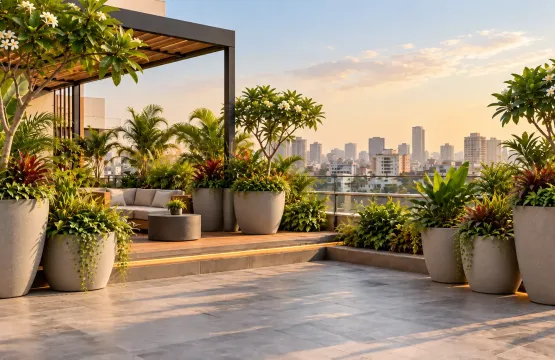
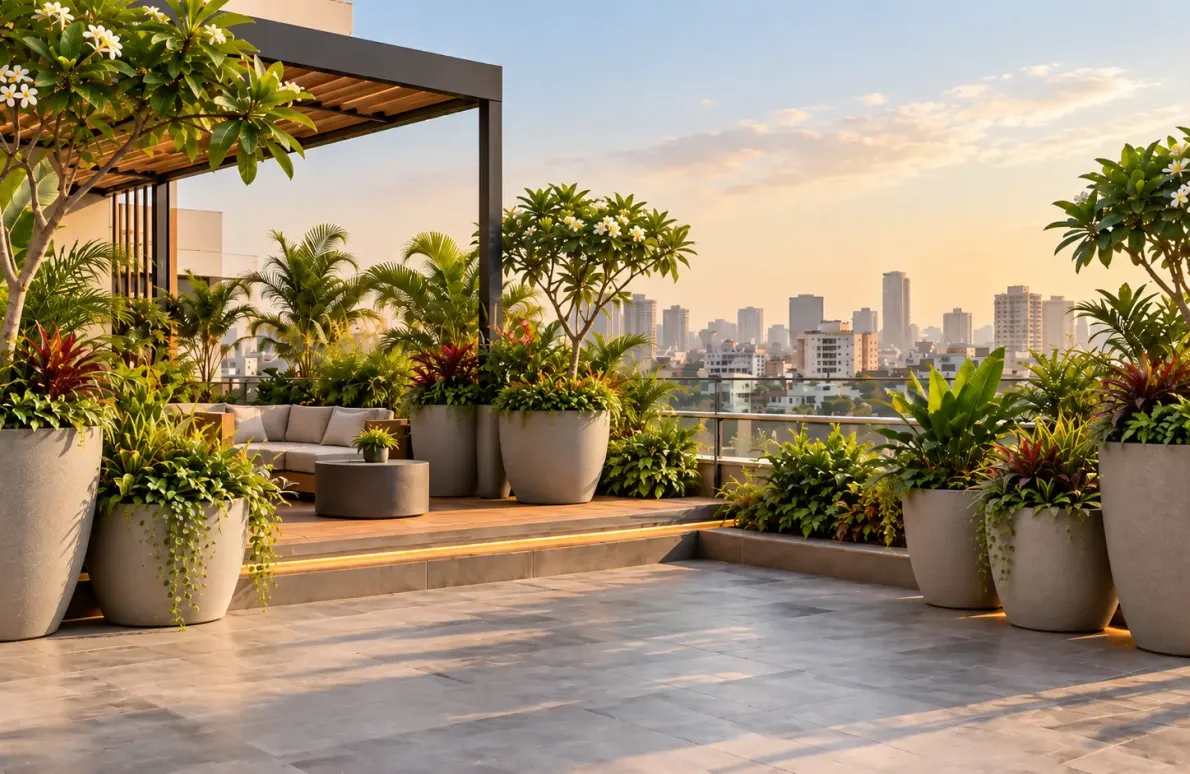
Rooftop gardens are becoming an important part of modern Indian architecture. Residential towers, hotels, offices, clubs, restaurants and commercial buildings are using terraces and rooftops as active outdoor spaces rather than leaving them as unused service areas.
A well-designed rooftop garden can improve the experience of a building. It can create green pockets, outdoor seating areas, walking zones, café spaces, wellness corners and quiet breakout areas. But rooftop landscaping is very different from landscaping at ground level.
On a rooftop, every material matters.
The planter is not just a container for plants. It affects slab load, waterproofing, drainage, installation, maintenance and the long-term performance of the rooftop garden. This is why FRP outdoor planters are becoming a practical choice for rooftop gardens in India.
FRP planters offer the right balance of low weight, strength, weather resistance and design flexibility. For projects where the garden is placed on a terrace, podium or rooftop slab, this combination becomes especially valuable.
Why Rooftop Gardens Need the Right Planters
A rooftop garden faces conditions that are very different from ground-level landscapes. The space is exposed to direct sunlight, wind, rain, heat, humidity and regular maintenance activity. At the same time, it sits on a structural slab with defined load capacity.
This means the planter selection cannot be made only on appearance.
A rooftop planter must be:
Lightweight
Durable
Weather-resistant
Easy to install
Safe for waterproofed surfaces
Designed with proper drainage
Stable in open wind conditions
Suitable for long-term outdoor use
Easy to clean and maintain
If the wrong planter material is selected, it can create issues such as excess dead load, cracks, staining, water leakage, difficult installation or frequent replacement.
FRP planters help reduce many of these concerns.
What Are FRP Outdoor Planters?
FRP stands for Fibre Reinforced Polymer. It is a composite material made using fibre reinforcement and polymer resin. In planter applications, FRP is valued because it can be manufactured into strong, lightweight and customizable forms.
FRP outdoor planters are suitable for rooftop gardens because they are much lighter than many traditional planter materials such as stone, concrete or thick masonry containers. At the same time, they can be produced in large sizes, clean profiles and custom finishes.
They can be used for:
Rooftop gardens
Terrace landscapes
Podium gardens
Residential amenity decks
Hotel rooftop lounges
Restaurant terraces
Corporate breakout spaces
Clubhouse terraces
Rooftop seating areas
Sky gardens
This makes them useful for both residential and commercial rooftop projects.
Lightweight Advantage on Rooftop Slabs
The biggest advantage of FRP planters for rooftop gardens is their low weight.
On rooftops, the structural slab has a load limit. The total load includes the planter, soil, water, plant material, people, furniture and other landscape elements. Heavy planters can quickly increase the load on the slab.
Stone, concrete or masonry planters may look strong, but they can become extremely heavy when filled with soil and water. This can create concerns for structural engineers, especially on existing buildings or large rooftop landscapes.
FRP planters reduce this pressure because the container itself is lightweight. This allows the design team to use larger-looking planters without adding unnecessary dead load.
For rooftop gardens in India, where many projects are planned on podiums, terraces and existing slabs, this weight advantage is one of the strongest reasons to consider FRP.
Better for Installation and Handling
Rooftop installation is often difficult. Materials may need to be moved through lifts, staircases, service areas or cranes. Heavy planters can slow down the process and increase labour and equipment requirements.
FRP planters are easier to handle compared to heavy stone or concrete alternatives. Their lightweight nature makes transportation, lifting and positioning more practical.
This is useful in:
High-rise residential towers
Hotels with rooftop restaurants
Commercial buildings with limited access
Existing terraces being upgraded
Podium landscapes with many planters
Projects with tight installation timelines
Easier handling also gives designers more flexibility during site placement. Planters can be positioned with less disruption and adjusted more easily during final landscape setting.
Drainage Is Critical for Rooftop Gardens
Drainage is one of the most important details in any rooftop garden. Poor drainage can lead to water stagnation, plant damage, staining, waterproofing stress and maintenance problems.
FRP planters for rooftop use should be designed with proper drainage provisions. The drainage should be coordinated with the landscape design and waterproofing system so water can move safely without collecting under the planter or damaging the surface.
Important drainage considerations include:
Drain holes or drainage inserts
Internal drainage layer
Proper soil mix
Avoiding direct water pooling on the slab
Coordination with terrace slope
Protection of waterproofing layer
Maintenance access for cleaning
A planter may look good, but if drainage is not planned properly, it can create long-term problems. For rooftop gardens, drainage detailing should be considered at the specification stage, not after installation.
Suitable for Indian Weather
Rooftop gardens in India face harsh weather conditions. In summer, planters are exposed to strong sunlight and heat. During monsoon, they must handle rain and moisture. In coastal cities, humidity and salt air can also affect materials over time.
FRP performs well in these conditions because it does not rust like metal and does not absorb moisture like porous materials. With the right exterior-grade finish, FRP planters can maintain their appearance in outdoor conditions with basic routine cleaning.
This makes them suitable for rooftop gardens in cities such as Mumbai, Pune, Bengaluru, Chennai, Hyderabad, Delhi, Kochi, Goa and other regions where outdoor planters need to handle sun, rain and humidity.
Design Flexibility for Rooftop Spaces
Rooftop gardens often have limited space, so planter design must be practical and visually clean. FRP gives architects and landscape designers freedom to create planters in different shapes, sizes and profiles.
FRP planters can be made as:
Long rectangular planters
Tall privacy planters
Low edge planters
Circular planters
Tapered planters
Modular planter units
Custom curved forms
Seating-edge planters
Large tree planters
Slim terrace planters
This flexibility helps the planter fit the rooftop layout instead of forcing the layout to fit standard pots.
For example, long linear FRP planters can define the edge of a rooftop seating zone. Tall planters can create privacy around an outdoor lounge. Low planters can mark pathways without blocking views. Modular planters can be repeated across terrace gardens for a clean, consistent look.
Creating Privacy and Green Edges
Many rooftop gardens are exposed to neighbouring buildings, surrounding towers or open city views. In such cases, planters can help create softer privacy edges.
Tall FRP planters with suitable planting can be used along terrace boundaries, seating zones and restaurant edges. They help define the space without creating a hard wall. This makes the rooftop feel greener, more comfortable and more private.
In residential buildings, planters can improve amenity terraces and clubhouse decks. In hotels and restaurants, they can create intimate seating areas. In offices, they can define outdoor breakout zones for employees.
This is where rooftop planters become more than plant containers. They become space-defining architectural elements.
Low Maintenance for Facilities Teams
Rooftop gardens need regular maintenance, but planter material should not add unnecessary work.
FRP planters are suitable for projects where facilities teams need durable, easy-to-maintain outdoor elements. Unlike metal planters, they do not require rust treatment. Unlike porous materials, they are less likely to absorb moisture or stain the surrounding surface when properly manufactured and installed.
Basic maintenance usually includes cleaning the surface, checking drainage, maintaining the plants and ensuring that the planter position remains stable.
For residential societies, hotels, offices and commercial buildings, this low-maintenance quality is important because rooftop spaces are expected to remain clean and presentable throughout the year.
Important Specification Points
Before selecting FRP outdoor planters for rooftop gardens, a few specification points should be checked carefully.
1. Planter Size
The planter size should match the plant type, root depth and rooftop layout. Oversized planters may look strong visually, but soil and water load must be considered.
2. Wall Thickness
Wall thickness should be suitable for the planter size and planting depth. Large planters need proper structural strength to handle soil pressure and outdoor exposure.
3. Drainage Detail
Drainage holes, inserts and internal layering should be planned in coordination with waterproofing and terrace slope.
4. UV-Stable Finish
For outdoor rooftop use, the surface finish should be suitable for Indian sun exposure. This helps reduce fading and surface degradation.
5. Base Protection
Planters placed on waterproofed slabs should have proper base detailing so they do not damage the surface below.
6. Wind Stability
Rooftop spaces can be windy. Tall or narrow planters should be checked for stability, especially when placed along open edges.
7. Maintenance Access
Planters should be placed in a way that allows watering, cleaning, drainage checks and plant maintenance.
Best Applications for FRP Rooftop Planters
FRP outdoor planters can be used in many rooftop garden applications.
For residential rooftops, they can define clubhouse terraces, seating decks, walking paths and green corners.
For hotel rooftops, they can create privacy around lounges, restaurants, pool decks and event areas.
For office terraces, they can support breakout zones, outdoor meeting corners and employee wellness areas.
For restaurants and cafés, they can create green partitions and soft boundaries without adding heavy construction.
For podium gardens, they can provide large planting zones while keeping load in control.
Final Thoughts
Rooftop gardens in India need planters that are not only attractive but also practical. The planter must support the design vision while responding to structural load, drainage, weather exposure and long-term maintenance.
FRP outdoor planters are well suited for this requirement.
They are lightweight, durable, weather-resistant, customizable and easier to install than many traditional planter materials. For terraces, podiums and rooftop gardens, these qualities make FRP a smart material choice.
A rooftop garden should not feel like an afterthought. With the right planter system, it can become a functional, comfortable and visually refined outdoor space.
For rooftop projects where load, drainage, durability and design flexibility are important, FRP planters can help create a more practical and long-lasting landscape solution.