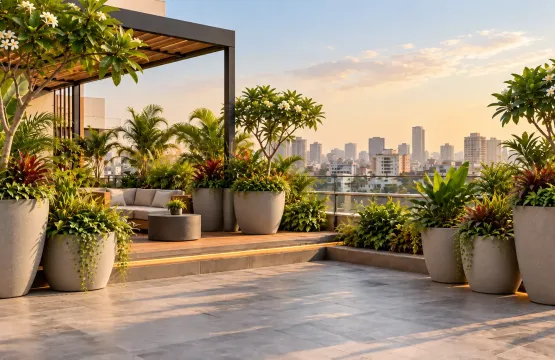
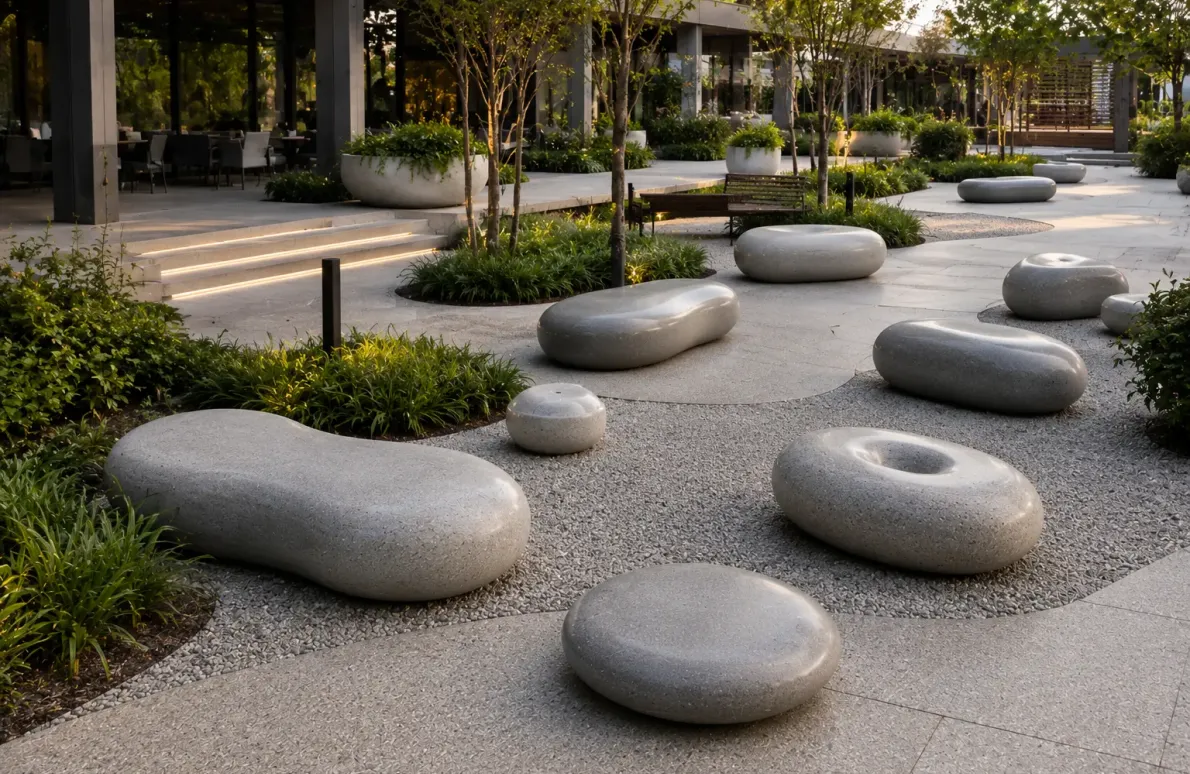
Most outdoor landscaping decisions start with the same question - where do we put the benches? It's a furniture-first way of thinking, and it shows. Walk through almost any resort, clubhouse, or commercial plaza and you'll see identical rows of straight-backed benches lined up along a path, functional but visually disconnected from the greenery around them, as if the landscape team and the furniture supplier never actually spoke to each other.
Architectural pebbles approach the same problem from the opposite direction. Instead of adding furniture to a landscape after it's designed, they treat seating and sculptural form as part of the landscape itself, from the very start.
Why Furniture-First Landscaping Falls Short
Conventional outdoor furniture - straight benches, rectangular planters, uniform seating modules - was designed for efficiency, not experience. It's easy to specify, easy to install in a grid, and easy to ignore once it's there. The problem is that people don't actually move through outdoor spaces in straight lines or gather in rigid rows. They cluster informally, pause where something catches their attention, and linger longer in spaces that feel organic rather than assembled from a catalogue.
This is the gap architectural pebbles are designed to close. Rather than treating seating as a separate category from landscaping, they blur the line between the two - a sculptural form that happens to double as a place to sit, or a focal point that happens to anchor a gathering space, rather than a bench that was simply set down on a lawn.
What Architectural Pebbles Actually Are
Architectural pebbles are sculptural landscape elements, typically manufactured in GRC (Glass Reinforced Concrete), shaped to echo the soft, rounded forms of natural river stones and boulders. Their organic geometry is deliberate - rounded profiles read as part of the natural landscape rather than as inserted infrastructure, even though their function is entirely architectural.
They generally fall into two categories. Seating pebbles are shaped and proportioned specifically to function as informal outdoor seating - low, rounded forms that invite people to sit individually or in small clusters, without the rigid orientation of a conventional bench. Designer pebbles function more as sculptural focal points - anchoring a courtyard, framing a garden threshold, or breaking up an open landscape zone visually, without necessarily being a seating surface themselves. Used together, the two types let a landscape designer compose a space the way a sculptor might, placing forms individually as accents or clustering them to create informal gathering zones.
Why GRC Is the Material of Choice
The material matters as much as the form. GRC gives architectural pebbles a combination of properties that would be difficult to achieve with more conventional outdoor materials-
Structural durability without the bulk of solid stone. GRC's dense, fibre-reinforced composition delivers strength and weather resistance comparable to natural stone, but at a fraction of the weight - which matters significantly when a project needs dozens of pieces installed across a large landscape.
Precise, repeatable sculptural forms. Because GRC is cast rather than carved, complex organic geometry can be reproduced consistently across multiple units, which is essential when a design calls for a cluster of pebbles that need to feel related to one another rather than mismatched.
Weather resistance with minimal upkeep. A dense, low-porosity finish resists staining, cracking, and surface degradation from sun and rain exposure, so outdoor installations hold their appearance for years without the repainting or resealing cycles that wood or painted metal furniture requires.
Finish flexibility that matches the design intent. GRC accepts a wide range of surface finishes - granite, sandstone, pigmented, pitted, and terrazzo textures among them - which lets a designer match the pebbles' surface character to the surrounding hardscape, whether that's a natural stone palette or a more contemporary, textured look.
Where Architectural Pebbles Change a Space
Resort and hospitality landscapes, where guest-facing outdoor areas need to feel curated and premium rather than functional and generic - pebbles arranged around a pool deck or garden path do more to signal design intent than a row of matching sun loungers ever could.
Residential podiums and clubhouses, where amenity spaces are increasingly judged on how "Instagrammable" and inviting they feel, not just how many seats they provide.
Commercial campuses and public plazas, where informal seating needs to accommodate unpredictable group sizes - a cluster of pebbles naturally seats two people or eight, without the awkwardness of an oversized or undersized bench.
Gardens and courtyards, where a single sculptural pebble can act as a focal point that gives an otherwise open lawn area a sense of composition and intention.
Designing With Pebbles Instead of Around Furniture
The most effective use of architectural pebbles comes from treating them as a landscape design tool from the earliest planning stage, not a furniture line item added at the end.
- Cluster rather than align. Grouping pebbles in irregular, informal arrangements - rather than lining them up - reinforces the natural, organic quality that makes them feel different from conventional furniture in the first place.
- Mix seating and designer forms. Combining functional seating pebbles with purely sculptural designer pebbles creates visual rhythm across a space, rather than a uniform field of identical seats.
- Let planting interact with the forms. Placing pebbles near or among planting beds, rather than isolated on open paving, reinforces the sense that they emerged from the landscape rather than being placed on top of it.
- Consider scale variation. A mix of pebble sizes within a cluster - some low enough to sit on, others larger and purely sculptural - creates a more natural, varied composition than uniformly sized units.
The Bottom Line
Outdoor landscaping succeeds or fails on a fairly simple test: does the space actually make people want to stop and stay, or does it just get walked through on the way to somewhere else? Furniture bolted onto a finished landscape rarely passes that test. Architectural pebbles are built around passing it - sculptural, durable GRC forms that function as seating and focal points while reading as a natural extension of the landscape itself.
DECO, from The Global Elephant, manufactures architectural pebbles in GRC seating and designer forms, available across a range of finishes for resorts, residential developments, commercial campuses, and public landscape projects.
To explore DECO's Architectural Pebbles range and finishes, visit DECO Architectural Pebbles by The Global Elephant.